

Salar de Uyuni
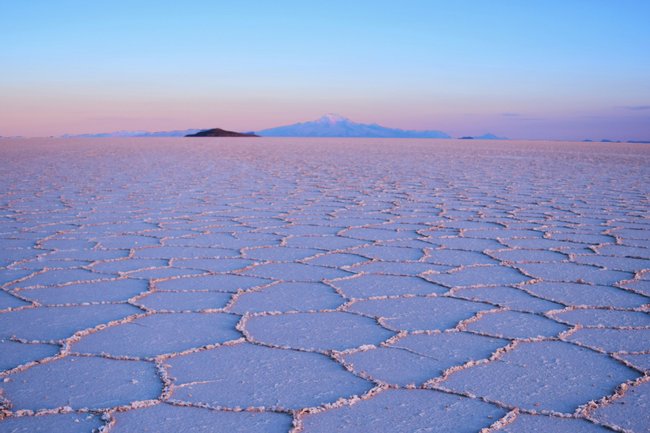
The world’s largest salt flat stretches over more than 10,500 square kilometres of mirror‑likesurface. Salar de Uyuni lies on the Altiplano of southwestern Bolivia, near the crest of the Andes at 3,656 m above sea level. It is the remnant of a series of Late Pleistocene lakes that left an 8‑meter‑thick crust of salt covering lithium‑rich brine.
The crust is so flat that the elevation varies by less than one metre across the entire expanse. In its centre, a few islands rise as the eroded tops of ancient volcanoes, their surfaces dotted with fragile coral‑like structures, fossils and algae. The salar serves as the main transport corridor across the Bolivian Altiplano and provides a breeding ground for several species of flamingo. Its stark landscape has attracted filmmakers, appearing in movies such as The Fall, Salt and Fire and Star Wars: The Last Jedi.
After a rain, a thin sheet of water spreads over the salt, turning the plain into the world’s largest mirror, a reflective surface that can extend 129 km across. The mirror‑like effect, together with the flatness of the ground, makes the salar ideal for calibrating the altimeters of Earth‑observation satellites. Daytime temperatures peak at 21 °C in the summer months, while night‑time lows fall to between –9 and 5 °C; humidity remains low at 30 % to 45 % and rain falls on fewer than five days per month except in January.
When water creates that 129‑kilometre mirror, the Salar de Uyuni becomes a precise reference that even satellite instruments rely on for measurement.

Insider-led Bolivia Design & Concierge
Your insider team designs the trip around what you care about, then supports you in-country with private logistics, vetted partners, and concierge help when plans change.