

Meteora
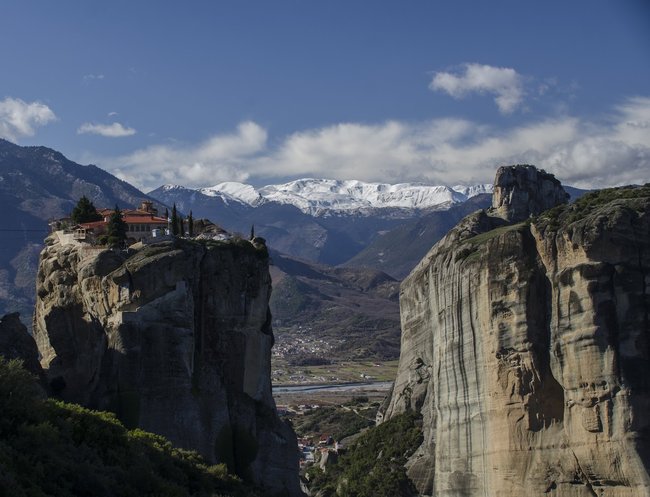
Rising pillars of stone that soar more than 20 metres above the Thessalian plain support a cluster of medieval monasteries. Meteora is a rock formation in the regional unit of Trikala, in northwestern Greece, positioned between the town of Kalabaka and the village of Kastraki. The site lies at the northwestern edge of the Plain of Thessaly, near the Pineios river and the Pindus Mountains. In 1988 the six surviving monasteries were inscribed on the UNESCO World Heritage List for their architecture and cultural significance.
Human presence in the area stretches back to the Paleolithic, with the Theopetra cave showing a stone wall built 23 000 years ago to shield against cold winds. By the 800s CE hermit monks began to occupy the sheer cliffs, living in hollows up to 550 metres above the plain and gathering only on Sundays for worship in a chapel at Dupiani. The first formal monastic community, the Skete of Stagoi, appeared by the late 11th century, centred on the still‑standing church of Theotokos.
From the mid‑14th century, under the patronage of the local lord Simeon Uroš, twenty‑four monasteries were erected on the pillars; today four remain active: the Great Meteoron (founded 1356), Varlaam, Holy Trinity and Saint Stephen, the latter converted to a convent in 1961. Two former monasteries, Saint Nicholas Anapausas and Rousanou, survive as historic structures. Access once required removable ladders, large nets or baskets hoisted by rope; in the 1920s steps were carved into the rock, allowing visitors to climb the 373‑metre cliff that frames the Varlaam monastery. The combination of towering geology and centuries‑old monastic architecture makes Meteora a singular landscape where faith and stone have endured together.