

La Paz
La Paz rests on the sheltered waters of the Bay of La Paz, where the night‑time Coromuel winds drift from the Pacific across the peninsula. It serves as the capital of the Mexican state of Baja California Sur and lies on the Gulf of California’s coastline. With a 2020 census count of 250,141 residents, it is the state’s most populous city.
The city spreads from sea level to a modest 27 metres, framed by the Sierra de la Laguna to the east, a range noted for more than one hundred endemic plant species. The municipality covers 20,275 km², making it the fourth‑largest in Mexico, and sits 210 km south of Ciudad Constitución, 202 km north of Cabo San Lucas, and 81 km north of Todos Santos. Its coordinates are 24°08′32″ N, 110°18′39″ W.
A subtropical hot desert climate governs daily life, with average temperatures ranging from 17 °C in winter nights to 30 °C in summer days. Rainfall averages 170 mm annually, concentrated between August and October, while over 300 days of sunshine bathe the city each year. Sea temperatures shift from about 20 °C in winter to 29 °C in summer, inviting water‑based activities throughout the year.
Cultural life centers on the annual Carnaval La Paz, one of the oldest festivals on the Baja Peninsula, where parades, music and traditional dances display Indigenous and colonial influences. The town appears in John Steinbeck’s 1947 novel The Pearl and his 1951 travelogue The Log from the Sea of Cortez, and it provides the setting for Scott O’Dell’s 1967 Newbery Honor book The Black Pearl. These literary connections, together with the distinctive Coromuel winds, give La Paz a character that lingers in the memory of every visitor.
Experiences in La Paz
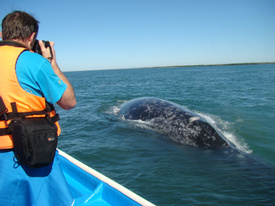
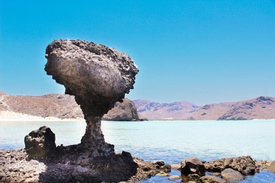
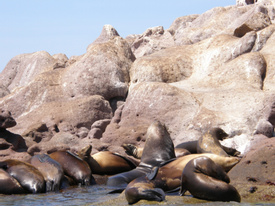
Explore hand-picked La Paz tours and experiences led by local insiders, from wildlife encounters to cultural deep-dives.