Insider-Led Myanmar Travel & Concierge
Expert local insiders design your Myanmar trip from scratch — hand-picked stays, private guides, and concierge support from first call to final day.
Browse our best hand-crafted itineraries
Get inspired and explore our curated collection of hand-crafted trips. From romantic honeymoons to family adventures, every itinerary is completely flexible and tailored to your needs.
Our Love Amidst The Gems of Burma
Celebrate your love with a luxurious journey for two exploring the gems of Burma. Become entranced by the beauty of Myanmar — and each other. Romance and adventure await you.

Our Romantic Adventure in Burma
See the sights with a more active approach. Trek through villages to experience the local culture up-close; bike your way through Mandalay, and balloon over Bagan.
Lovin' & Livin' in Myanmar
This itinerary combines all the highlights that Myanmar has to offer, paired with premium accommodations to give you plenty of time to rest and relax during your Burmese getaway.
Elevating Our Family Vacations
Rediscover the joy of travel on this amazing adventure that takes your family on a voyage through Myanmar. There will be beaches, but this is far from the average vacation.
Our Vacation in The Past & Present
Zip back and forth between the lakes, temples, and beautiful beaches of Burma with an active adventure. The journey is part of the action as you boat, bicycle, and walk.
Our Myanmar Bucket List Journey
Do you really want to check it all off of your bucket list? Take your family around Myanmar in style! This trip takes you to all the highlights while you stay in premium hotels.
Solo Temple Expedition
This itinerary is an economic way to see a lot of the country and enjoy a variety of interesting tours. Meet other travelers along the way, or enjoy the beauty of Myanmar in peace.
My Solo Temple & Trekking Adventure
Treat yourself to an exceptional vacation when you explore Myanmar in style. Enjoy a variety of transportation modes, exquisite accommodations, and awesome adventures.
Myanmar, Meet ME - My Trip to Burma
Treat yourself to a solo adventure of Burma’s best when you book this Signature Trip. You’re going to hit all of the nation’s highlights. Spoiler Alert: There are a lot!
Create your own Myanmar itinerary
Work with our local experts to design a journey that fits your pace, interests, and budget perfectly. From hidden waterfalls to private beach villas.
Your dates, your pace.
Hand-picked stays & experiences.
Private local guides throughout.


The best places to visit in Myanmar
From iconic landmarks to hidden gems — explore the destinations our local insiders recommend most in Myanmar.
Inle Lake
Nestled in the high Shan Hills of eastern Myanmar, the breathtaking natural wonder known as Inle Lake serves as the center of a bustling boating community. Although a few things around the lake can be reached by car, the only real way to experience this lake culture is to hire a boat and immerse you.
Explore DestinationYangon
Once the colonial capital of the British empire, Yangon is a city that represents the ancient, the old, and the new. With pagodas that date back several millennia, century-old remnants of colonialism and constant construction on new high-rise buildings, Yangon represents both the history and future of Myanmar. It just takes a little exploration and one is quickly immersed in the diversity this city has to offer.
Explore DestinationNgapali Beach
Out of its 1,200 miles (1,931 km) of coastline, Ngapali Beach is by far the crown jewel of Myanmar seaside getaways. Just a short plane ride from the busy streets of Yangon brings you to the peaceful, palm tree lined shores. A tranquil retreat along the Bay of Bengal, visitors come here for the white sand beaches.
Explore DestinationBagan
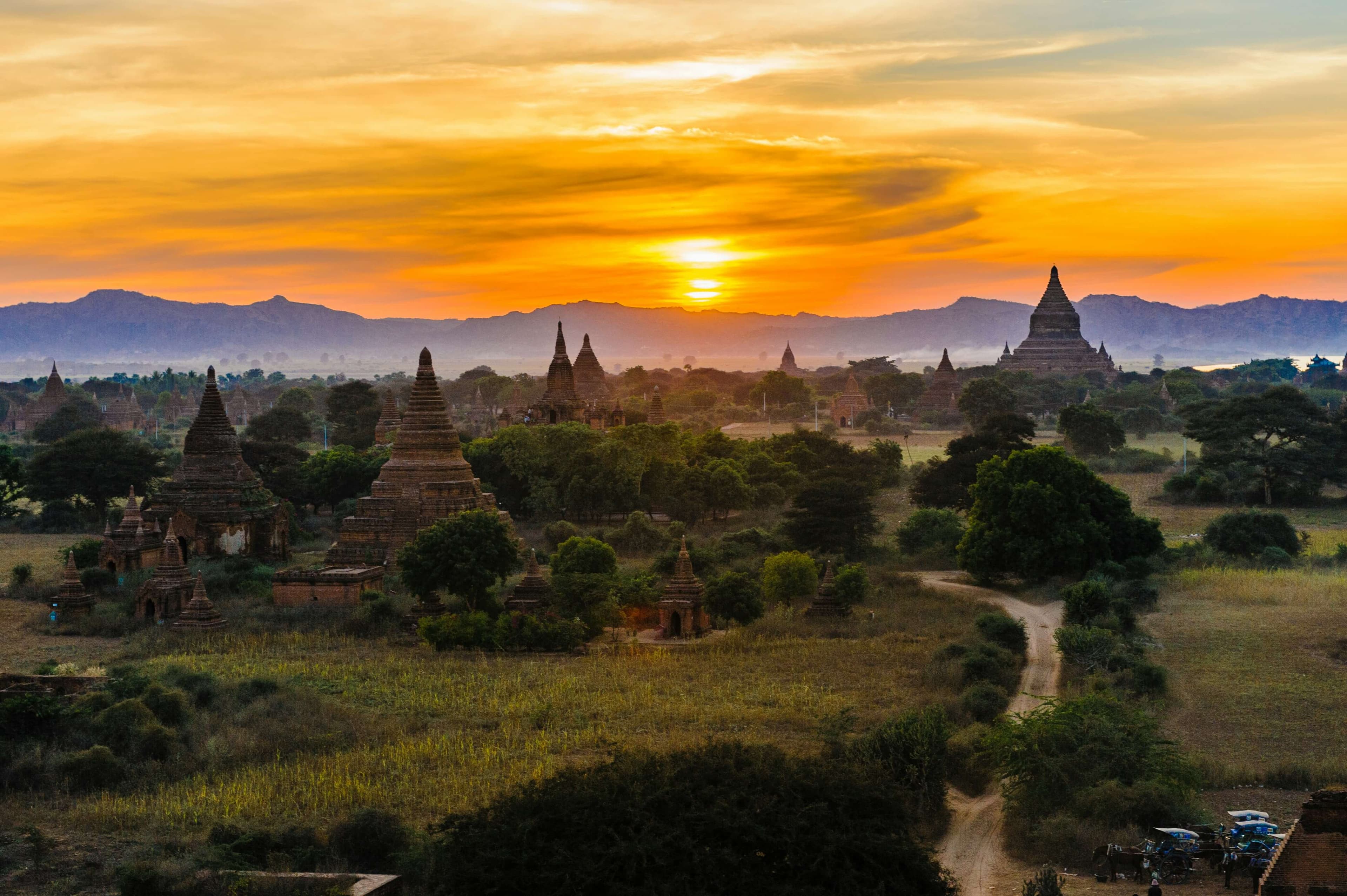
Leaving early under the cover of darkness is the only way to experience one of Myanmar's most breathtaking spectacles — sunrise in Bagan.
Explore DestinationMandalay
Built along the Ayeyarwady River, the city of Mandalay is steeped with both ancient and modern cultural intrigue. High red-bricked walls and a large moat separate the ancient palace from the rest of Myanmar's second largest city. Inside the fortifications sit a completely reconstructed palace, much like the one that stood there in the 18th and 19th centuries.
Explore DestinationNgapali Beach
Out of its 1,200 miles (1,931 km) of coastline, Ngapali Beach is by far the crown jewel of Myanmar seaside getaways. Just a short plane ride from the busy streets of Yangon brings you to the peaceful, palm tree-lined shores. A tranquil retreat along the Bay of Bengal, visitors come here for the white sand beaches.
Explore DestinationInle Lake
Nestled in the high Shan Hills of eastern Myanmar, the breathtaking natural wonder known as Inle Lake serves as the center of a bustling boating community. Although a few things around the lake can be reached by car, the only real way to experience this lake culture is to hire a boat and immerse you.
Explore DestinationOld Bagan
The ancient outer wall of Old Bagan still stands today, marking the entrance to the original heart of the capital city. It encircles the landward side of the city which is located next to the Ayeyarwady River. This area is known for its hot air balloon rides with an incredible view of the sprawling ruins.
Explore DestinationIn their words
After a half-century of isolationist policies imposed by an oppressive military junta, the newly elected government of Myanmar ushers in a hope for a brighter future. This government is now led by Nobel Laureate, Aung San Suu Kyi, whose political party recently won a supermajority of open parliament seats in the government. This new political era has garnered increased global attention and seen visits from such world leaders as President Barack Obama. The stabilizing forces of the new political regime have also attracted foreign investment as well as lead to an explosion in tourism. With Myanmar's vast collection of archeological sites, rich buddhist culture, diverse topography and warm-spirited people, now is a perfect time for travellers to discover the mystique that surrounds Myanmar.
Nestled between India, China, Thailand, Laos and Bangladesh, Myanmar has long been a natural juncture for trade. The large amount of neighboring countries may also help to explain why Myanmar has a staggering 135 different ethnicities. There are also still elegant remnants from Britain's 124-year rule displayed in colonial architecture across the country. Mostly however, visitors will quickly find themselves steeped in the rich traditions of Buddhism, as Myanmar's overwhelming devotion to this religion permeates every facet of daily life.
Out of Myanmar's 1,200 miles of coastline, Ngapali Beach is one of the most beautiful and popular destinations. A small airport conveniently delivers tourists to the doorsteps of luxurious Western-style resorts. Daytime activities include boat trips where visitors enjoy fishing, snorkeling or exploring on the nearby islands. One may also just lounge on the white sand beaches while tranquilly gazing across the the teal-colored waters of the Bay of Bengal. Around dinner time, the Westward facing beach restaurants make an excellent vantage point to watch the sunset while dining on freshly caught seafood.
Myanmar is about the size of Texas with a landmass of 261,228 square miles and contains multiple types of topographies. Both the West and East sides of the country are hill regions, with the Western side rising quickly in elevation as it heads North towards the Himalayas. The Eastern edge of the Himalayan mountain range extends into the extreme North of the country, where Hkakabo Razi stands at 19,294.62-feet (5,881 meters) as the tallest point in Myanmar. The central region is mostly flat and dominated by the mighty Ayeyarwady River system as it makes its way South until separating into multiple tributaries and spilling into the sea. In the South, Myanmar has 1,200 miles of shoreline that border either the Bay of Bengal or the Andaman Sea.
Myanmar has a tropical monsoon climate with the ideal months for visits being from November-March. Temperatures during this period range from 70°F(21°C) to 85°F(30°C.) High humidity along with a scorching sun can make the air feel quite balmy, especially in the lower valley areas of Mandalay and Yangon. Up in the hill regions like around Inle Lake, the temperature can get cool in the evenings and nights. The climate surrounding the Himalayas in the North is quite the opposite and can see snow during the winter months.
In 2015, the first open elections in Myanmar in decades were held. Longtime political dissident, Aung San Suu Kyi, saw her National League for Democracy party win a supermajority of open parliament seats. The optimism of this new government comes after decades of harsh rule imposed by a military junta, which took power from a newly formed democracy decades before. The junta imposed martial law under the guise of bringing stability to the country, which some claim was heading towards a civil war. Before this, Myanmar was ruled as a British colony for 124 years during the late 19th and early 20th centuries. The British succeeded the Konbaung Dynasty, which was the last Burmese dynasty to hold power. Leading up to the Konbaung rule, various Burmese dynasties had governed the country for thousands of years from cities such as Bagan, Yangon, Inwa and Mandalay.
With a 135 ethnicities represented within the country's borders, Myanmar's population of 57 million people is quite diverse. The Burmese represents about 70% of the residents in a country that is 87% Buddhist. Everywhere a traveller goes, they will undoubtedly see the saffron colored robes of the hundreds of thousands of monks that inhabit the country. One will be quick to notice that the most up-kept parts of Myanmar are the monasteries, temples and pagodas, which are usually adorned with intricate woodwork and gold leaf. In a country with 26% of the people living in poverty, these holy sites sit in stark juxtaposition to the squalor of many of its residents.
Before the military junta took power, Myanmar's vast natural resources made it one of the richest countries in Southeast Asia. Through isolationist government policies, the economy contracted to rank as one of the smallest in the region. As the country changes its political policies and opens itself up to the global economy, it stands poised to regain much of the ground it lost. Beyond tourism, Myanmar has vast timber reserves, large precious stone deposits and ample natural oil and gas waiting to be tapped.