



- Getting Around
Costa Rica Transportation: Domestic Flights, Rental Cars, Shuttles & Ferries
Anywhere Costa Rica's Costa Rica insiders default to a private, English-speaking driver for airport arrivals, families and remote lodges — see our Private Drivers guide. Domestic flights, rental cars, shuttles, ferries and public buses are covered below for the rest of your trip planning.
What Our Customers Say

Costa Rica Transportation: Domestic Flights, Rental Cars, Shuttles & Ferries
How convenient are shuttle transports in Costa Rica?
There are many shared shuttle transport options in Costa Rica, especially between popular destinations. They are typically air-conditioned minibus (or coasters) that have multiple departure times throughout the day. For your convenience, some of these shuttles can pick you up and drop you off at your hotel. Be sure to reserve shuttle buses in advance, and make sure you keep your vouchers on hand when you board! Expect some bumpy roads when the trips are longer distance journeys, but drivers will typically stop for breaks to let you stretch your legs!

Shuttles are an economical option to get around Costa Rica. You can swap stories with your fellow travelers or simply relax. Anywhere Experts recommend this method of transport for travelers who are looking for economical ways of getting from place to place, especially for group sizes of 1 – 3 people. However, if the size of your party size is larger then you can also consider private transport with more flexible departure times and a better price.
Are there private transports I can reserve?
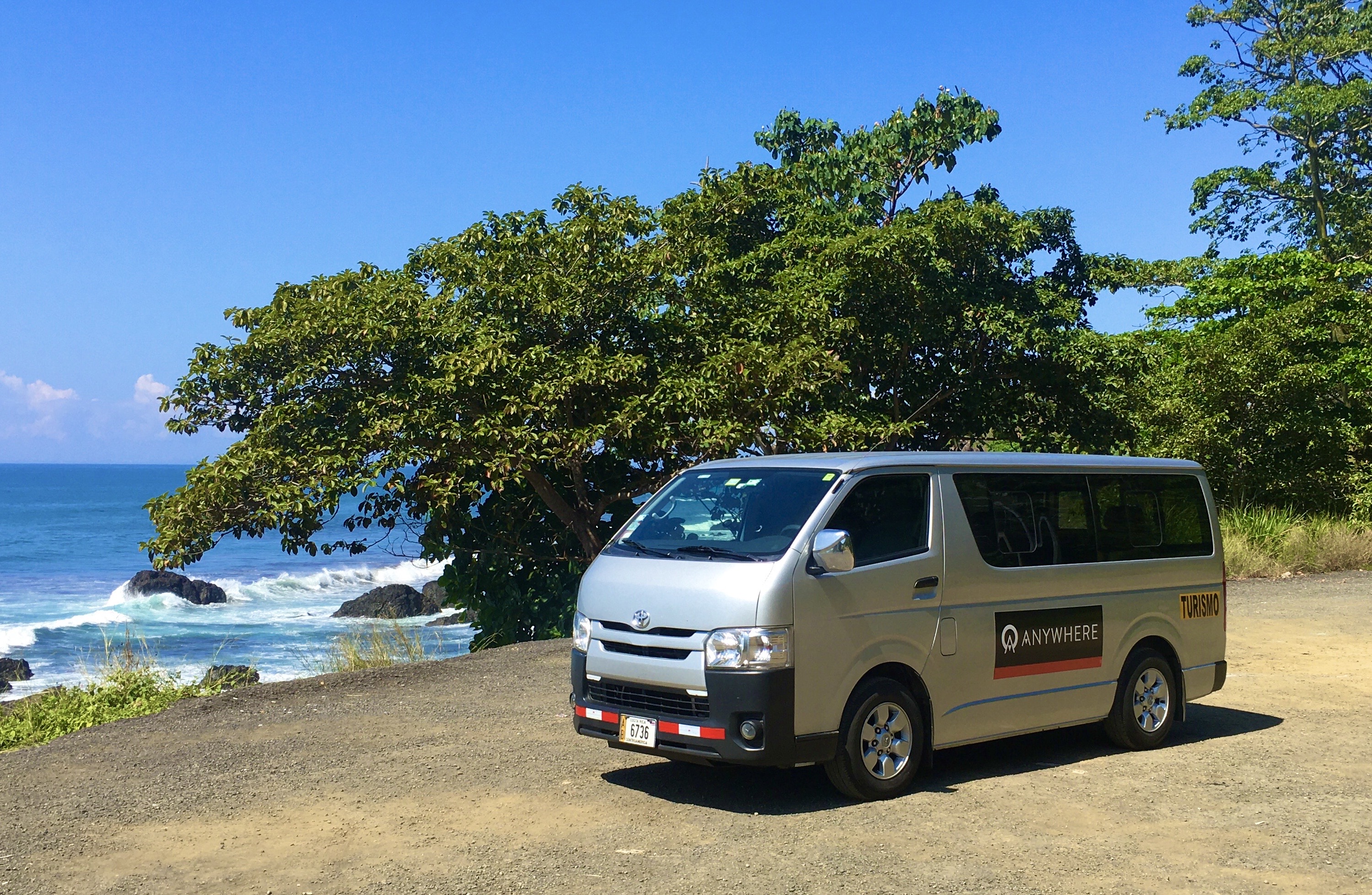
Spend more of your vacation on your own time when you choose private transportation.
Want to thoroughly relax and know that every leg of your journey is taken care of? Private transport is the easiest — and the most popular — way to go. It’s safe, convenient, and flexible for your group’s need. It allows for opportunities to enjoy Costa Rica’s beautiful scenery in a relaxed state. You can even arrange for some free stops along the way to visit souvenir stores or enjoy a meal in a restaurant. Drivers are typically knowledgeable guides who can point out things of interest on the way to your destination. Don’t miss the chance to ask for their recommendations — locals knows best!
“On our way to La Fortuna to the airport, our driver was amazing and tells us all about Costa Rica and the towns we drove through. He even pulled over and helped us rescue a sloth that was trying to cross the road, which meant a lot to us and was an unforgettable experience. He pointed out some poison dart frogs as we walked back to the van. Overall he was great and we would have happily driven with him anywhere” – Hayley
Rest assured that at Anywhere, we collaborate with the most reliable vehicle providers who are professional and help you move about the country safely.
What is the difference between a shared shuttle and a private transfer in Costa Rica?
A private transfer carries only your party, door to door, at the time you choose; a shared shuttle runs on a fixed timetable with other travelers. With a private driver you can stop for lunch, a viewpoint or a souvenir shop along the way, and a tour between destinations can be built in if it's arranged ahead. Shared shuttles cover the popular routes between main destinations, collect guests from several hotels, may not reach every lodge or match every flight time, and can run 10 to 15 minutes either side of the stated time. Both use air-conditioned minivans with licensed drivers; keep your voucher handy and your bags ready at pickup.
Our Costa Rica Insiders default to private transfers for airport arrivals, families and remote lodges, and use shared shuttles where a set schedule suits. Compare private transfer options.
Can I rent a car to go around Costa Rica? What are the roads like?
Yes. You can drive in Costa Rica on your valid home driver's license for as long as the tourist stay stamped in your passport (up to 180 days), and you must carry your passport, not a photocopy, while driving. Rental agencies set their own minimum driver age and hold a security deposit on a credit card, so confirm both before you book.
Main routes are paved, but most are two-lane roads that wind through the mountains, many bridges narrow to a single lane (yield where you see Ceda el Paso), and the final stretch to many eco-lodges is gravel. From June to November, heavy rain brings potholes and landslides. A 4x4 is worth it for Monteverde and the Osa Peninsula, and our Costa Rica Insiders advise against driving after dark, when unlit curves and faded lane markings catch visitors out. In San José, private cars may only enter on certain weekdays, based on the last digit of the license plate, so ask your rental agency. Never leave bags visible in a parked car.

On a first trip, many of our travelers use a private driver for the long transfers and a rental car only for a beach base.
What are approximate driving times between destinations in Costa Rica?
The general rule of thumb is 30 mph (50 km/hour). Take a look on Google map and estimate the approximate distance to gauge your driving time. Most main roads are two lanes with very little room to pass, and it is frequently shared by trucks that can slow down the lane. From Alajeula SJO airport to popular destinations such as Manuel Antonio, Arenal, and Monteverde, it usually takes 3 – 4.5 hours. We advise reserving private transport so you can take a well-deserved rest after a long international flight!
What is the fastest way to get around Costa Rica?
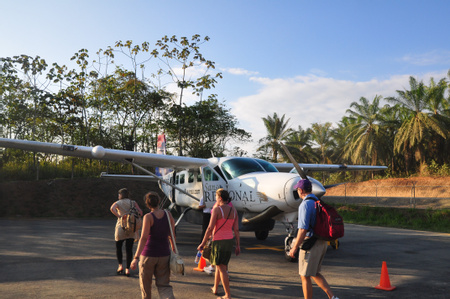
A domestic flight is the fastest option on most long routes: San José to Tortuguero takes about 35 minutes in the air, against about four and a half hours overland. Two scheduled domestic airlines fly from the domestic terminal at Juan Santamaría International Airport (SJO). SANSA serves Bahía Drake, Cóbano (for Montezuma and Santa Teresa), Golfito, La Fortuna (Arenal), Liberia, Nosara, Puerto Jiménez, Limón, Quepos (Manuel Antonio), Tamarindo and Tortuguero; Costa Rica Green Airways serves Quepos, Cóbano and Puerto Jiménez. For groups, we can also quote private charters.
The planes are small, so luggage allowances are strict and schedules can shift with the weather. Our Costa Rica Insiders build in a buffer and have a driver waiting at the airstrip. See domestic flight options.

Domestic flights are an excellent way to visit diverse regions in the span of a single vacation.
What is a taxi-boat-taxi transfer in Costa Rica?
A taxi-boat-taxi swaps part of a long road journey for a boat crossing: a van takes you to the water, a boat crosses, and a second van meets you on the far side and drops you at your hotel. The best-known route links Arenal and Monteverde across Lake Arenal. It takes about three and a half hours door to door, much like the road, but trades a rough mountain drive for lake and volcano views. On the Pacific, a boat across the Gulf of Nicoya connects Jacó with Montezuma in about an hour, and Manuel Antonio with Montezuma or Santa Teresa in about four, against roughly six hours by road and car ferry.
The car ferry itself, run by Naviera Tambor between Puntarenas and Paquera, sails eight times a day in each direction. Boats depend on sea and lake conditions, so your Costa Rica Insider keeps a road alternative ready.
Can I take public buses around Costa Rica?
Yes. Public buses connect nearly every town and are how many Costa Ricans get around, and fares are low. They are also slow, timetables and routes are not always accurate, and pickpockets target tourists on board, as Canada's travel advisory notes. If you ride, keep your passport and valuables on you rather than in the overhead rack or under the seat, and carry proof of your legal stay, because police sometimes check passengers' documents.
For travelers on a set itinerary, shuttles, private transfers and domestic flights save hours and keep luggage in safer hands. Our Costa Rica Insiders plan each leg so it lines up with hotel check-in and tour times.
Are ATV tours in Costa Rica bad for the environment?
They can be. Off-road quads compact the soil, cut ruts that speed up erosion and send sediment into streams, and their noise drives wildlife away from feeding and nesting areas; on unpaved rural roads, the dust they raise also settles on the people who live alongside.
If an ATV ride is on your list, choose an operator that rides on its own private trails rather than through forest, rivers or beaches, stay in the center of the track so it doesn't widen, cross streams slowly, and skip rides in the wettest months when trails turn to mud. Quads roll easily, so leave the driving to adults and follow the guide. Check your travel insurance too: quad biking is often excluded from standard policies. For lower-impact adventure, our Costa Rica Insiders suggest hanging bridges, rafting or a guided night walk. See ATV tours run on private land.