
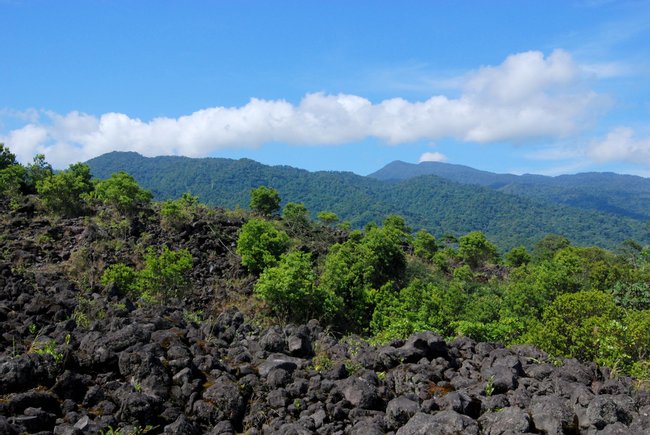
Arenal Volcano National Park
The Arenal Volcano National Park packs all of Costa Rica's allure into one place: incredible hiking, magnificent views, abounding wildlife and the country's most active volcano. Hiking and horseback riding tours allow you to get up close and personal with this incredible area, which encompasses close to 30,000 acres (12,000 ha) and extends into eight different life zones. Overlooking everything is the imposing Arenal Volcano which sits right inside this wonderful park.
Plan my TripPlanned with a local insider, takes just 2 minutes.
Of the 850 total species of birds identified in Costa Rica, close to all of them, including the endangered resplendent quetzal, can be found inhabiting the area. This provides an excellent stage for excited birders. Also keep your eyes open for moose, white-faced monkeys, jaguar, deer, coati, toucans, and snakes like the infamous fer-de-lance and parrot snake.
What distinguishes this park from all the rest, though, is the Arenal Volcano, which is among the world's 10 most active volcanoes. Not to worry though, the last major eruption was in 1968; since then, the majority of the volcanic activity consists of smoldering cinder-blocks and vibrant lava emissions flowing down its side. Park officials will not hesitate to close down the park if they feel conditions are too dangerous, as park visitor safety is the primary concern.
While exploring the park you will see plant life which includes guayabo de monte, laurel, cirri, various species of palms, orchids, heliconias, ferns, strangler figs, bromeliads, and many others. A popular hike is to pass through the park's tropical rainforest to old lava beds and then climb the Chato Volcano (Volcan Chato). Its extinct crater houses a water filled lagoon with a liberating view standing at 3,609 ft (1,100 m) on top of Arenal's little sibling.
Visitors can purchase maps and inquire for information at the park's ranger station which is 10 miles (16 km) west of Fortuna. The park is open from 8 am to 6 pm and there is an entrance fee of $7 USD. Any trip to the park requires a camera and a sense of adventure, as you will see a very active volcano like never before. After a long day, visit the soothing hot springs for some rehabilitating relaxation.
Wildlife Sightings
Spotted at Arenal Volcano National Park
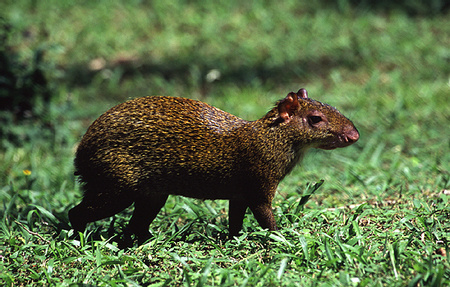
Agouti
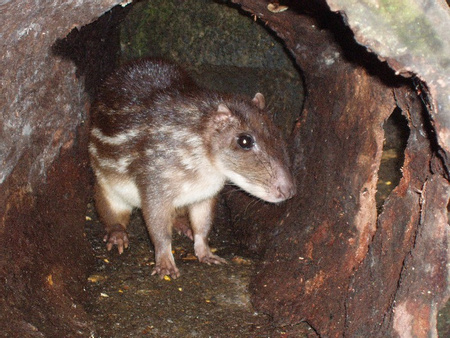
Paca
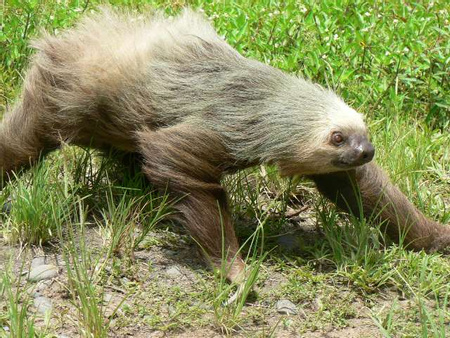
Sloths
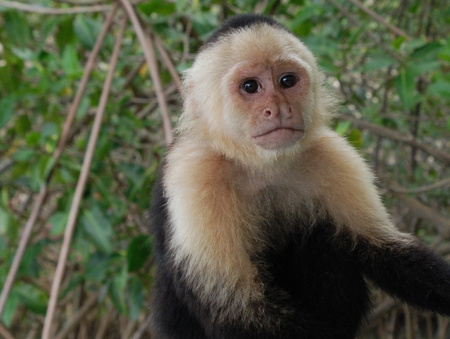
White-faced capuchin monkey
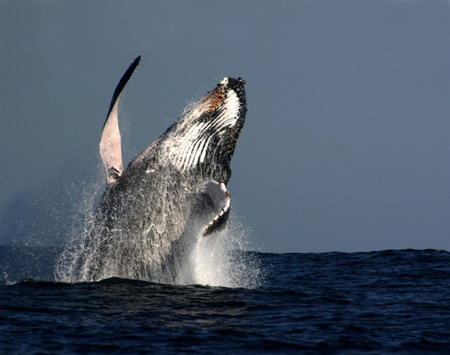
Humpback whale
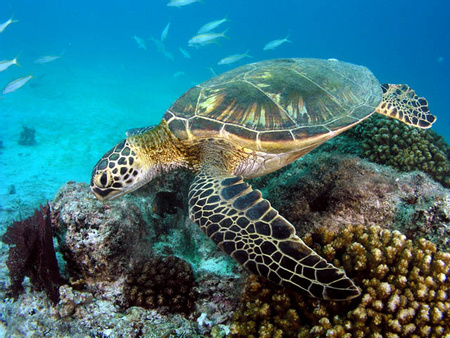
Sea turtles
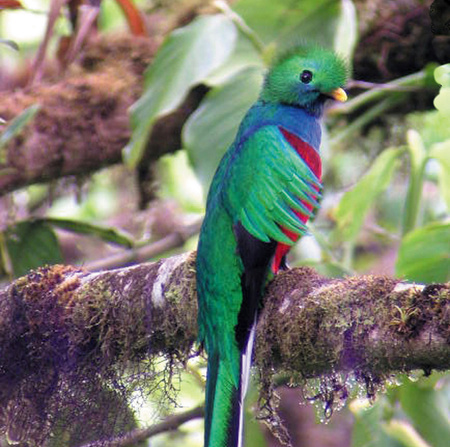
Resplendent quetzal
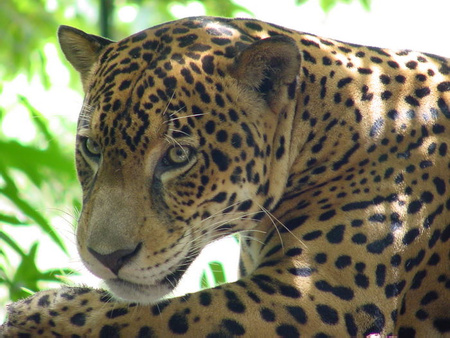
Jaguar
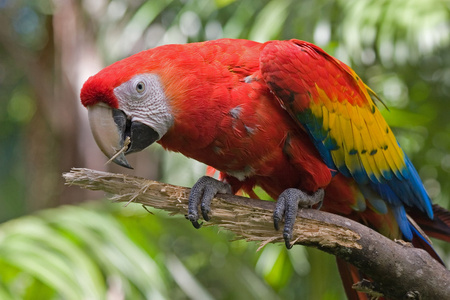
Scarlet macaw
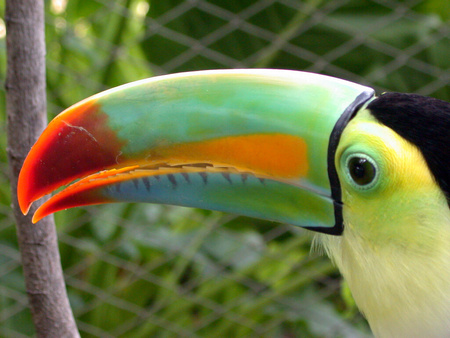
Keel-billed toucan
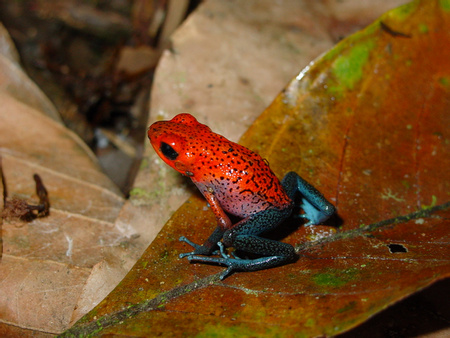
Blue jeans frog

Howler monkey
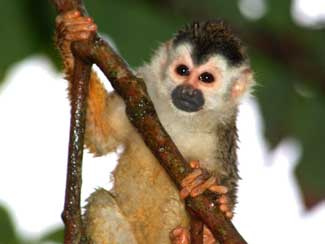
Squirrel monkey
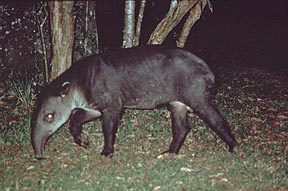
Baird's tapir
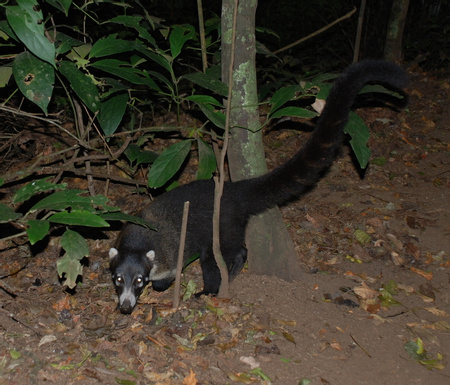
Coati
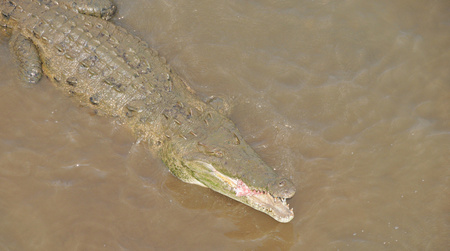
American crocodile
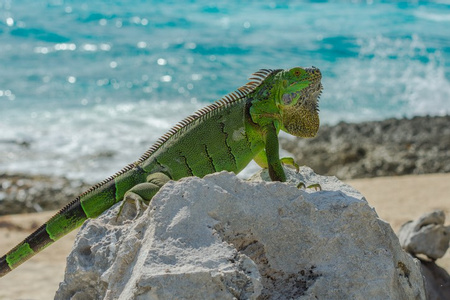
Green iguana
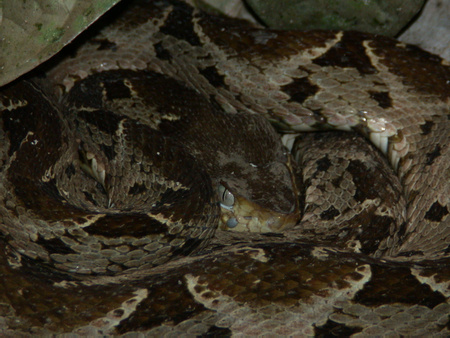
Fer-de-lance
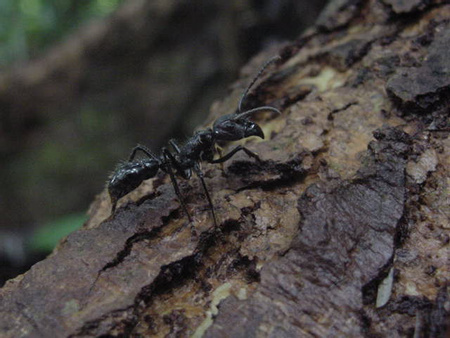
Bullet ant
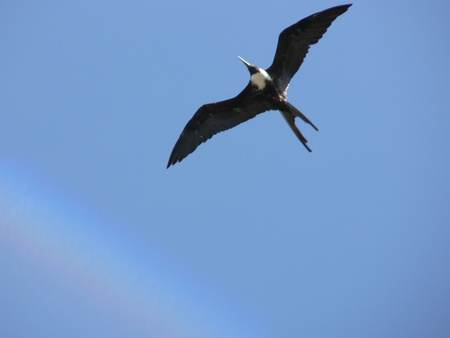
Magnificent frigatebird
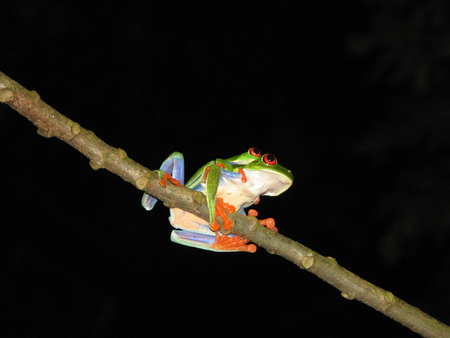
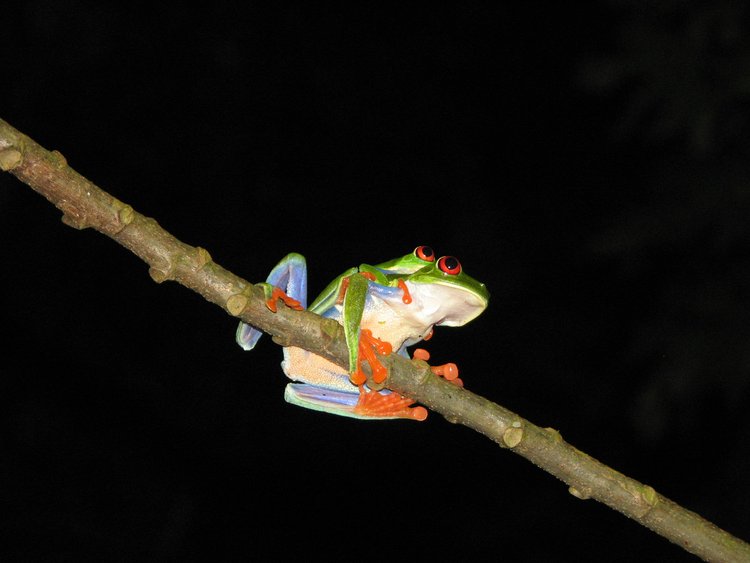
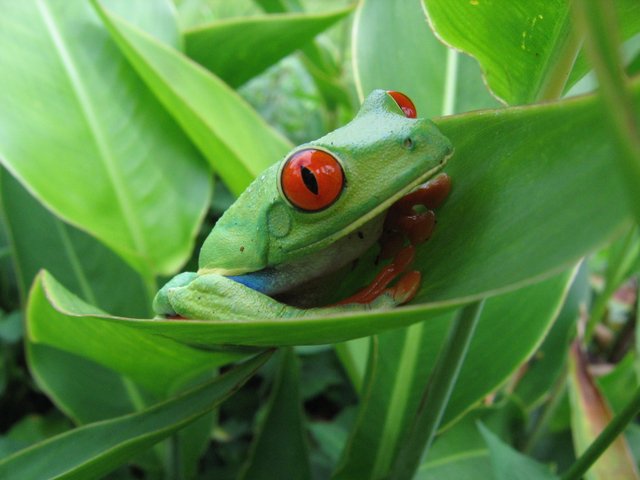
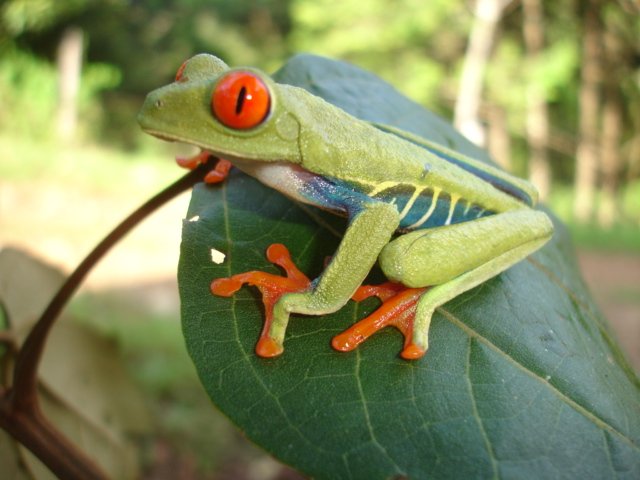
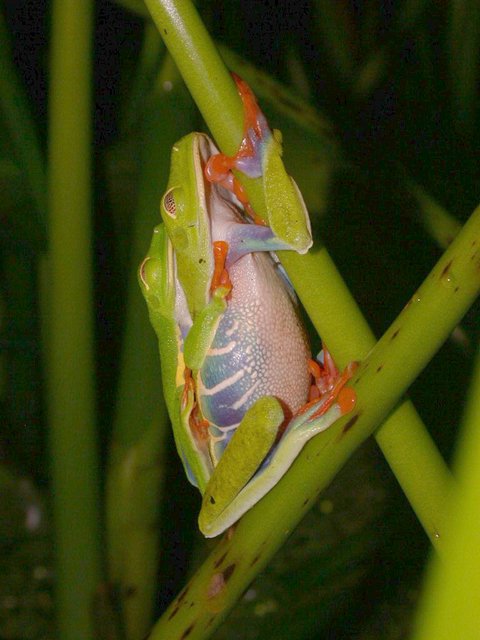
Red-Eyed Leaf (Tree) Frog
Red-Eyed Leaf (Tree) Frog (Agalychnis callidryas). Spanish name: Rana Ojos Rojos
Habitat and Range
Treetops conceal this bright species in lowland moist and wet forests, in some premontane wet forest and rainforest, and in disturbed habitats and mangroves. The frog can be found as high as 1,200 m, but tends to stay at low elevations.
The Leaf Frog lives from Mexico to eastern Panama.
Physical Description
The namesake huge red eyes, long, narrow body, and distinct coloration make this tree frog stand out among other species. The frog’s back is a bright green to help it blend into the treetops when the frog is sitting still. When it moves, it exposes bright orange hands and feet that have large, sticky finger disks, and dark blue thighs with white or cream vertical bars. When the frog sleeps, it rests on its white belly, keeping its bright hands and thighs folded out of sight. When the frog is startled, the flashes of bright color confuse its attacker as the frog escapes.
Biology and Natural History
The striking Red-Eyed Leaf (or Red-Eyed Tree) Frog has become a widely photographed and recognized amphibian in Central America.
In the forest this frog hides among branches during the day and dry times. It is more active during the rainy season, making trips to breeding ponds at night. Instead of hopping or walking like frogs that spend a lot of time on the ground, this frog climbs hand over hand through the trees. The adhesive disks on its toes and fingers help the frog cling to surfaces that are entirely vertical; this species also has a toe joint that keeps the toe disk flat on a surface no matter how the frog positions its feet. This frog can even parachute, by spreading out its gangly limbs and large feet and dropping from higher perches to lower branches.
On nights in the early rainy season, the tree frogs descend to breed. Males call “chock” as they move from perch to perch, waiting for a female to approach. When she does, the male climbs onto her back in the amplexus position and she begins to carry him around as they look for a site for their eggs. Males sometimes compete for a female, or a latecomer tries to remove a male already on the female’s back. A second male may even mount the female next to the first male (females are quite a bit larger than males) and share in fertilization as the female deposits the eggs. Before laying the eggs, she carries her mate(s) to water, fills her bladder, and then deposits the eggs where they will stay until they hatch, usually on the surface of a leaf hanging over water. She lays 20-50 eggs, the male fertilizes them, and then the female empties her bladder full of water on the eggs to keep them moist. The mating pair may repeat this process for up to 5 clutches of eggs that night. The female will lay eggs on two nights each breeding season.
When the tadpoles are ready to hatch, they wiggle free of the eggs and drop into the water below. Before they hatch, they may perish from drying out, predation, or slipping off the leaf too early. Bats, birds, and snakes may eat the adults despite the weak toxins in their skin.
Diet
The Red-Eyed Tree Frog feeds on moths, crickets, and other insects that are active at night.
Height/Weight
Adult females, at 51-71 mm, can be nearly twice the size of males, which are 30-59 mm.
Taxonomy
Order: Anura
Family: Hylidae
Sources
Henderson, Carrol L. Field Guide to the Wildlife of Costa Rica. University of Texas Press, Austin, 2002.
Leenders, Twan. A Guide to Amphibians and Reptiles of Costa Rica. Zona Tropical, S.A, Miami, FL, 2001.
Savage, Jay M. The Amphibians and Reptiles of Costa Rica: A Herpetofauna between two Continents, between Two Seas. The University of Chicago Press, Chicago, 2002.
Amy Strieter, Wildlife Writer
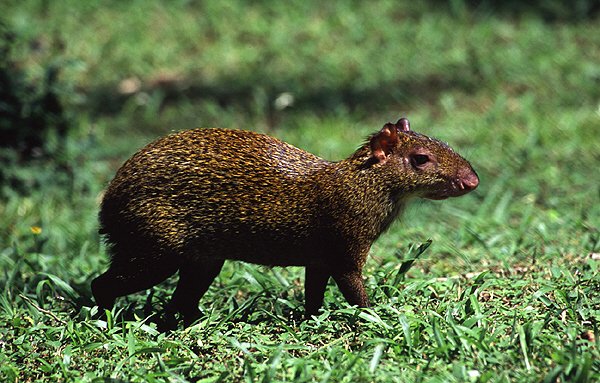
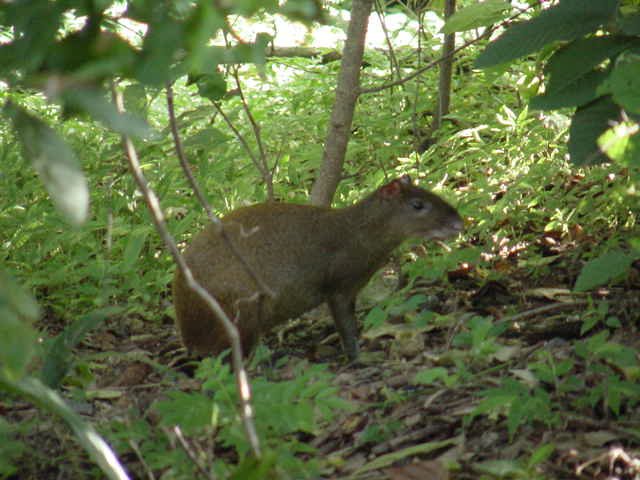
Agouti
Agouti (Dasyprocta punctata). Spanish name: Aguti, Picure
Habitat
They can live in the driest deciduous forests to the wettest tropical evergreen forests.
Range
Agoutis can be found between southern Mexico and northern Argentina.
Physical Description
Within its range, the agouti is the most frequently found diurnal mammal in low-to-middle elevation rain forest. This small mammal is related to guinea pigs and chinchillas and is a relative of the paca. The agouti is reddish brown to black with a white, yellow, or gray underside.
Biology and Natural History
The agouti is diurnal unless it is too severely hunted; then it becomes more active at night. It is an important seed disperser for plants in its habitat: the agouti buries food in small caches that it will recover if fruit becomes scarce. If it does not return to these seeds, they may grow into plants and replenish the sources from which the agouti feeds. An agouti is capable of eating seeds with very hard seed coats, because while eating it may sit on its haunches in order to watch for predators-this gives it time to work on the seed. While sitting on its back legs, it can use its forepaws to hold the seed in place and gnaw on a specific spot.
One or two baby agoutis are born at a time in one of their mother's several sleeping spots. They are born extremely developed, and are very active soon after birth. Early in the morning on their first day, the mother takes them to potential nest sites dug by other animals, often consisting of crevices or burrows. The babies choose one site and prepare their own nest with leaves and twigs. Agoutis nest in homes too small for predators to enter-but this means the mother is also too large to enter the nest site. Instead, she calls the young in the morning and evening to feed.
These mammals communicate extensively through odor signals. For example, they mark their trails and feeding and sleeping spots by dragging odor glands across objects. Males will even mark potential mates by spraying urine on them as part of their courtship ritual (pacas do this as well). Adult males defend their territory to ensure the paternity of their offspring.
While agoutis are not necessarily antisocial, an individual agouti avoids any other agouti that walks directly toward it, because such an action is presumably provocative. To fight, agoutis of the same sex may run towards each other, leap just before they make contact, and kick each other with their strong hind legs, which can cause serious damage to both fighters. In the presence of predators, however, their main defense is to flee, as they repeat high-pitched barks to warn family within the territory. If they are directly encountered by a predator, they will raise hairs on the rump to appear larger; if a predator tries to bite this large tuft of hair, they will miss the skin of the agouti and it will have a greater chance of escaping.
Diet
Agoutis eat mostly fruit, including the seeds.
Height/Weight
Head and body length ranges from 41.5 to 62 cm; they weigh about 4 kg.
Taxonomy
Order: Rodentia
Family: Dasyproctidae
Sources
Eisenberg, John. Mammals of the Neotropics, Vol. 1. The University of Chicago Press: Chicago, 1989.
Smythe, N. in Janzen, Daniel H. Costa Rican Natural History. Chicago: University of Chicago Press, 1983.
Wilson, D. E. in Janzen, Daniel H. Costa Rican Natural History. Chicago: University of Chicago Press, 1983.
Amy Strieter, Wildlife Writer
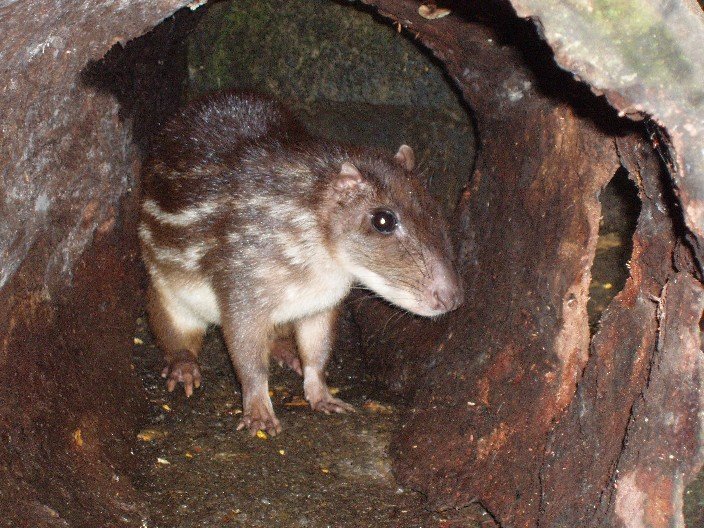
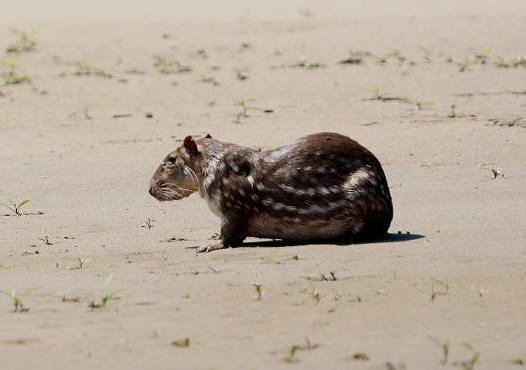
Paca
Paca (Agouti paca). Spanish name: Paca, Lapa, Tepezcuintle
Habitat
The paca generally stays in moist lowland habitats but may also live in seasonally arid areas near permanent streams or bodies of water.
Range
Pacas range from southern Mexico to northern Argentina.
Physical Description
This nocturnal mammal is larger than its relative the agouti, and is twice the agouti's weight. Generally brown to black, with four lines of white dots on each side of body, the agouti lives solitarily with the exception of a mother rearing her young.
Biology and Natural History
Pacas like to eat in the darkest places possible. If they are encountered with a threat, they can sprint quickly, but more often escape danger by leaping away and staying still for up to 45 minutes. Since they do not usually run to escape, they can store fat for times of scarcity, whereas the agouti stores food in caches in the ground. In addition to leaping and freezing to escape danger, pacas have a thin outer layer of skin that can tear very easily in the jaws or claws of a predator, so it is difficult to grasp them before they get away. Pacas may also escape by running to a body of water and submerging themselves; they may have developed this behavior in response to the now rare bush dog (Speothos venaticus).
To deter potential predators, pacas also use vocal sounds and grind their teeth to make an incredibly loud, ominous noise. A male will also roar and fight to defend his territory. When fighting becomes necessary, pacas battle by standing head to head and gnashing at each other with their large incisors. Pacas do not use odor signals to communicate as extensively as agoutis do, but like agoutis, male pacas marks potential mates by spraying urine on them as part of the courtship ritual.
An adult female occupies an exclusive home range except for her mate and young offspring. One infant, or rarely, twins, are born furry with open eyes; newborns stay in a burrow dug by the mother or previously used by an armadillo. During the day the mother will cover the entrance with leaves.
Diet
Pacas mostly eat fruits, nuts, seeds, and during some parts of the year, plant vegetation.
Height/Weight
The head and body length is approximately 60-80 cm; their short, vestigial tail is 2 cm long. They weigh about 10 kg. Adult males are usually 15% larger than adult females.
Taxonomy
Order: Rodentia
Family: Dasyproctidae
Sources
Eisenberg, John. Mammals of the Neotropics, Vol. 1. The University of Chicago Press: Chicago, 1989.
Smythe, N. in Janzen, Daniel H. Costa Rican Natural History. Chicago: University of Chicago Press, 1983.
Wilson, D. E. in Janzen, Daniel H. Costa Rican Natural History. Chicago: University of Chicago Press, 1983.
Amy Strieter, Wildlife Writer
Photos: Courses.washington.edu/tesc404/barbara/index.htm (1)
Tours & Activities
Experiences in Arenal Volcano National Park
Explore hand-picked Arenal Volcano National Park tours and experiences led by local insiders, from wildlife encounters to cultural deep-dives.
Tour
Tour
Tour
Tour
Tour
Trips to Inspire
Arenal Volcano National Park itineraries
Explore hand-picked Arenal Volcano National Park itineraries designed by local insiders who know every hidden corner. Each trip is completely flexible, customized to your pace, travel style, and budget.
From $1,126 per person
9 days · Arenal, Manuel Antonio
Couple
We both love nature and hiking so Costa Rica is ideal for both of those. We went during what’s considered the rainy season so you need to be aware of that going in. It rained at some point almost every day we were there but we still had a very enjoyable time. We visited La Fortuna and Manuel Antonio. We enjoyed La Fortuna more. La Fortuna was more jungle whereas Manuel Antonio was more coastal and felt more touristy.
Costa Rica
From $1,324 per person
9 days · Monteverde
Friends
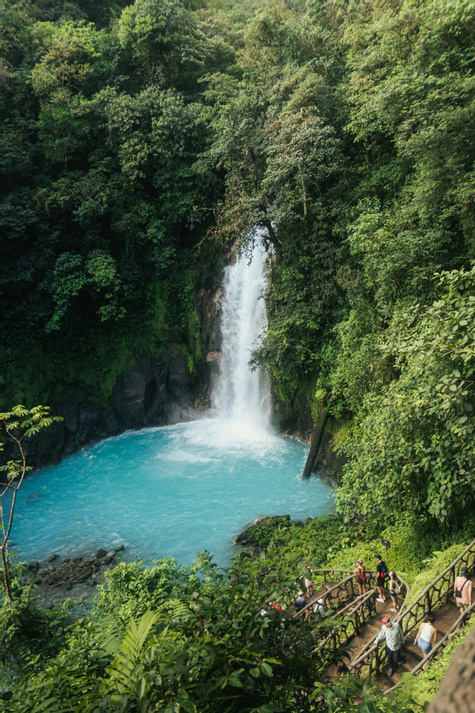
Embark on a vibrant Costa Rican adventure that juxtaposes bustling urban energy with lush, untouched rainforests, delivering a dynamic escape from everyday routine. From San José’s lively streets you’ll head to Monteverde’s cloud‑forest canopy for sky tram rides and hikes, then dive into Rio Celeste’s turquoise waters and trek El Silencio’s volcanic paths. Friendly locals and knowledgeable guides will immerse you in coffee farms, rainforest sounds, and volcanic vistas, leaving you with lasting memories of Costa Rica’s spirited hospitality and natural wonder.
Costa Rica
From $2,556 per person
12 days · San Jose, Tortuguero, Arenal, Playa Grande Guanacaste
Couple
Costa Rica has a diverse landscape and every area is unique and different. We easily rented a 4 wheel drive vehicle and drove from the Caribbean to the Pacific!
Costa Rica
From $2,102 per person
9 days · Manuel Antonio, Arenal, Tamarindo
Family
Embark on a vibrant Costa Rican family adventure that weaves together rainforest mist, volcanic fire, and Pacific surf, offering a dynamic contrast of nature’s extremes. Your journey moves from the sun‑kissed beaches of Manuel Antonio to Monteverde’s misty hanging bridges, then into Arenal’s volcano and waterfalls, ending with surf lessons in Tamarindo. Friendly local guides and coffee‑farm hosts will share traditions, flavors, and stories, leaving your family with lasting memories of Costa Rica’s warm hospitality and adventurous spirit.
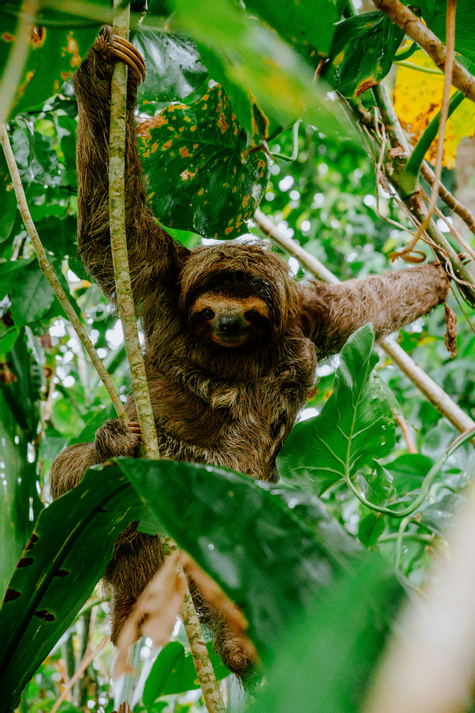
Costa Rica
Inquire
8 days · Arenal, Manuel Antonio
Friends
Costa Rica is a beautiful place - the biodiversity in terms of animals and plant life is spectacular. The beaches, the natural landscapes - all of it is stunning. The people are kind and welcoming, truly living the Pura Vida lifestyle.
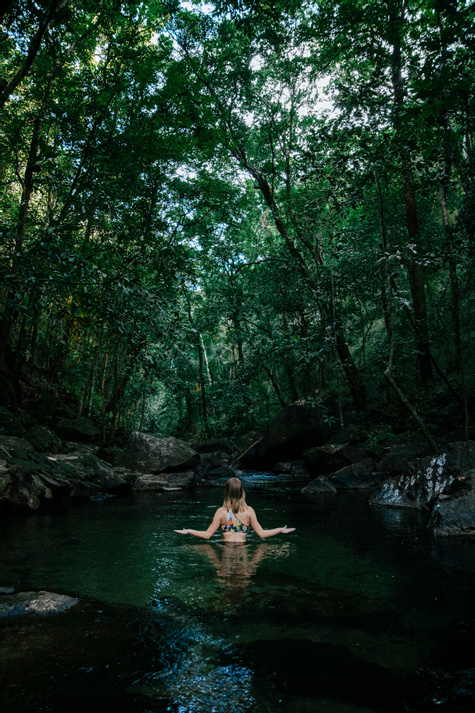
Costa Rica
Inquire
36 days · Puerto Viejo de Limon, Tortuguero, Arenal, Monteverde +4
Couple
From misty cloud forests to sun‑kissed Pacific beaches, this Costa Rican adventure weaves together vibrant wildlife, volcanic landscapes, and endless ocean horizons. You’ll trek Monteverde’s canopy bridges, soak in Arenal’s hot springs, kayak mangroves at Drake Bay, and snorkel coral reefs off Manuel Antonio. Friendly local guides and community hosts will share traditions, cuisine, and conservation stories, leaving you with unforgettable memories of Costa Rica’s pura vida spirit.
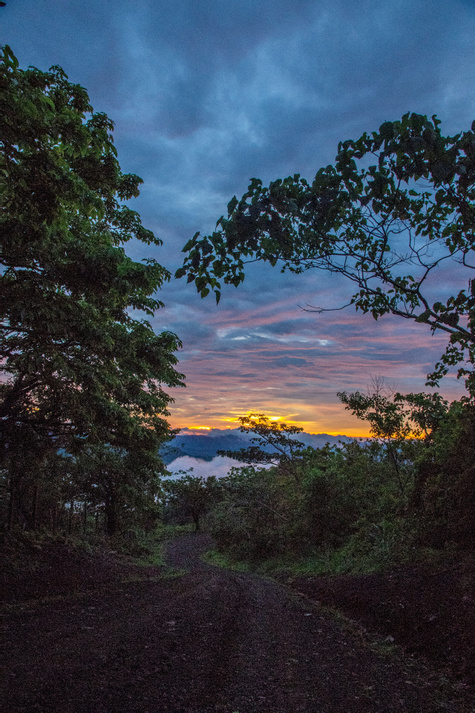
Costa Rica
Inquire
5 days · Arenal
Solo
This is my second trip using Anywhere to book a trip to Costa Rica. For the short time I was there, I had nothing but phenomenal service and helpful guides to make the trip amazing.
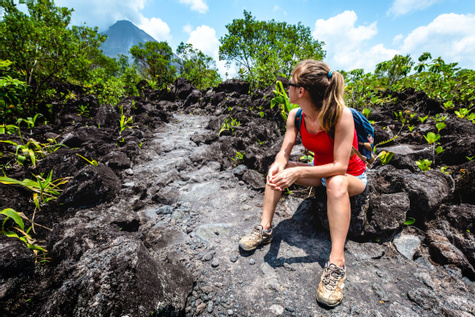
Costa Rica
Inquire
7 days · Monteverde, Arenal
Couple
Everyone who helped us - especially Lester - was amazing and so kind! We loved our trip to CR, the ticos and all that the country had to offer. Highly recommended.

Costa Rica
From $1,463 per person
8 days · Monteverde, Arenal
Family
The trip to Costa Rica was very memorable. My family and I enjoyed a lot. We did many things like rappelling, rafting for the first time. We saw lovely birds and animals. Anywhere team consisting of Leo Navarro did a great job of organizing and making the logistics part of travel as comfortable as possible. We did not have to worry about anything. Everything was taken care of. Costa Rica is beautiful place with great culture and very tourist friendly. Loved the place !
Costa Rica
From $928 per person
11 days · Playa Hermosa Guanacaste, Arenal, Monteverde, Manuel Antonio
Family
This is our favourite family trip ever. We'll come back to visit or live.
Costa Rica
From $2,282 per person
9 days · Arenal, Tortuguero, Puerto Viejo de Limon
Friends
Costa Rica is an unforgettable paradise. 5% of the world's total bio diversity. We can't wait to go back and we'll definitely be booking our next adventures through Anywhere Costa and their networks of amazing companies, guides etc that they work with. Book with them and you'll be so happy that you did.

Costa Rica
From $1,353 per person
16 days · San Jose, Puerto Viejo de Limon, Arenal, Monteverde +2
Couple
It was a beautiful holiday; we had a lot of fun and relaxation. There are a lot of things you can do in Costa Rica –– we never got tired. We saw amazing sights and animals, the 'Pura Vida' lifestyle is unforgettable!
Costa Rica
From $2,691 per person
18 days · San Jose, Arenal, Monteverde, Manuel Antonio
Couple
At Monteverde Lodge, we really appreciated that they placed water jugs in each room and offered ice and fresh fruit for the water each evening. This would be a great idea for other accommodations - we would be less inclined to buy water in plastic bottles for the room, and it would indicate that the tap water was great to drink (if that was the case).
Costa Rica
From $2,095 per person
15 days · Monteverde, Manuel Antonio, San Jose, Tortuguero +2
Couple
Our favorite part of the trip was experiencing all of the wildlife, monkeys, birds, butterflies and the scenery was GORGEOUS! Each portion of our two-week stay went according to plan, and we have many fond memories for our next trip!

Costa Rica
From $1,427 per person
15 days · Playa Hermosa Guanacaste, Arenal, Manuel Antonio, Monteverde +1
Family
We wanted to take the kids to Costa Rica to appreciate the ecotourism. Monteverde region blew us away with the Twilight Walk, Children's Eternal Rainforest and the cabins and greenhouse at Los Pinos, including the cabins designed to profit from natural light in the washrooms. The butterfly garden tour in Monteverde was my father's favourite of the many tours that we took and my children appreciated the coffee tour in Arenal for the hot chocolate that we made and for Gustavo's enthusiasm and interaction with the kids. Exposure to the nature was one thing but seeing how the society embraces nature for conservation was truly impressive.
Costa Rica