
Resplendent Quetzal
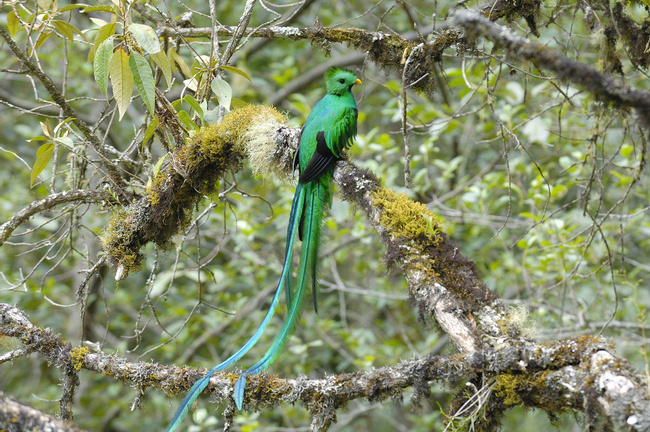
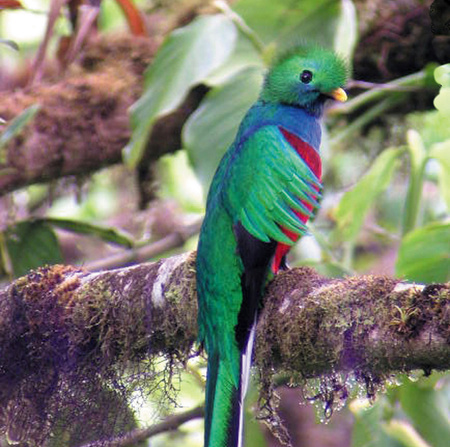
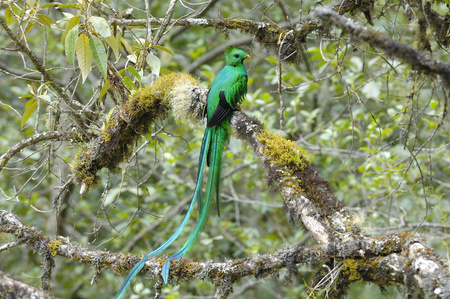
Attractive, impressive, richly colorful—this bird lives up to its name. Resplendent Quetzal (Pharomachrus mocinno). Spanish name: Quetzal (ket-saal’).
More about Resplendent Quetzal
Habitat
The Quetzal prefers damp mountain forests, and is most active in the canopy and edges; it may survive in heavily deforested areas, but only if there remain woods with adequate feeding and nesting trees.
Range
This bird persists from southern Mexico to western Panama, at elevations between 1,500 and 2,500 m.
Physical Description/Interesting Biology
With stunning, inimitable plumage and grace, the Quetzal is named for its splendor. The Aztec word, quetzalli, was used for this bird's tail feathers, and also meant "precious,' or "beautiful.' This shy trogon is the national bird of Guatemala, and is also popular in Costa Rica. In every part of its range, this bird is endangered because the cloud forest on which it depends has been extensively destroyed.
Alone, in pairs, or in a small flock after breeding, the Quetzal forages in fruiting tries, sallying to snatch fruits or very small animals before returning to the nest. They sing with distinctly smooth, deep, melodious calls that may echo far through the forest. They are usually in the canopy, but during courtship the male may chase the female lower and through the forest. In another impressive courting display, the male spirals high above the canopy before plunging back to the female in the canopy, his long tail feathers rippling behind him.
These legendary tail feathers that can be a meter long are one of the salient traits of the male Resplendent Quetzal. Adult Quetzals have a grey and black striped tail, and are covered in shimmering green on the head, back, and wings, so they blend into the wet foliage of the cloud forest. The females have somewhat similar plumage, but lack the green crest and bright red breast of the males, as well as the elongated tail feathers.
The parents work together to carve nest holes out of decaying trunks or they enlarge holes made by woodpeckers, toucans, or other animals. They depend on finding dead wood because their beaks and claws cannot penetrate live wood. The pair shares the work of incubating the 2 eggs and later feeding the chicks, as well as defending the territory around the nesting tree.
Finding sufficient nesting trees is the main direct limitation on Quetzal survival. It is naturally difficult for them to find trees with wood soft enough for nest excavation, because such trees usually decay before falling. Habitat destruction compounds the challenge to find nesting sites. Humans in Central America are devastating cloud forest area for timber, charcoal, cattle pasture, agriculture, or shifting slash-and-burn agriculture by native farmers. There are already reserves in Costa Rica and Guatemala in which the Quetzal still survives, but if the Resplendent Quetzal is to endure, it would be most beneficial to have a system of cloud forest parks from Mexico through Panama.
Diet
The Quetzal mostly eats fruits of the avocado family, as well as figs. Its diet also includes insects, small frogs, snails, and lizards. It drinks water from the bases of bromeliads.
Height/Weight
This bird as an adult weighs 210 g and has a body 36 cm long; the male's tail streamers may add up to 64 cm.
Brief Taxonomy
Order: Trogoniformes
Family: Trogonidae
Sources
A. LaBastille in: Janzen, Daniel H. Costa Rican Natural History. Chicago: University of Chicago Press, 1983.
Skutch, Alexander F. and F. Gary Stiles. A Guide to the Birds of Costa Rica. Utica: Cornell University Press, 1989.
-Amy Strieter, Wildlife Writer
Resplendent Quetzal Sightings
Similar Profiles
Great Green Macaw
Flora & Fauna
Violet Sabrewing
Flora & Fauna
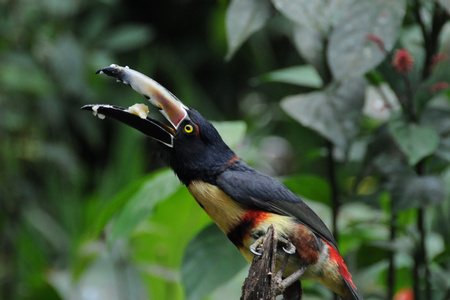
Fiery-billed Aracari and Collared Aracari
Flora & Fauna
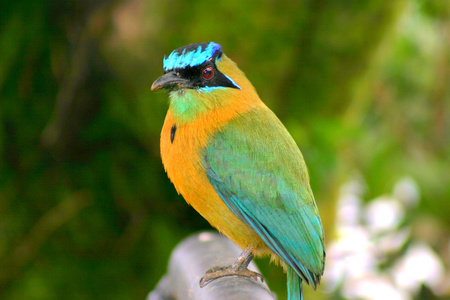
Turquoise-browed Motmot, Bird - Vertebrate
Flora & Fauna
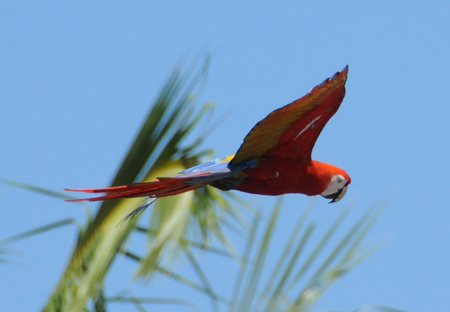
Scarlet Macaw
Flora & Fauna
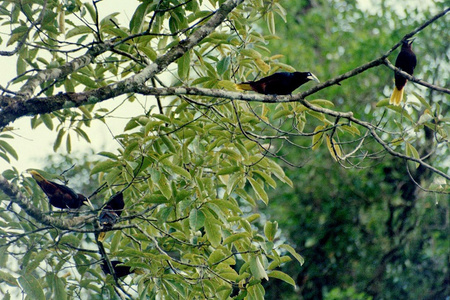
Chestnut-headed Oropendola
Flora & Fauna
Resplendent Quetzal
Flora & Fauna
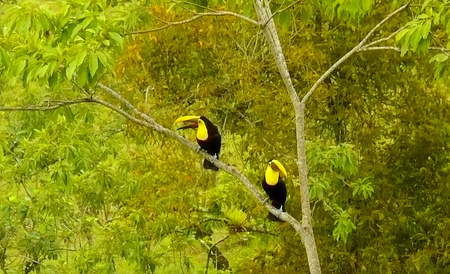
Chestnut-mandibled Toucan
Flora & Fauna
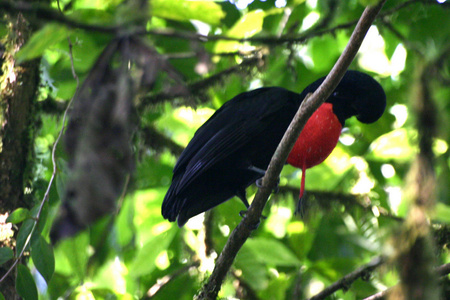
Bare-necked Umbrellabird
Flora & Fauna
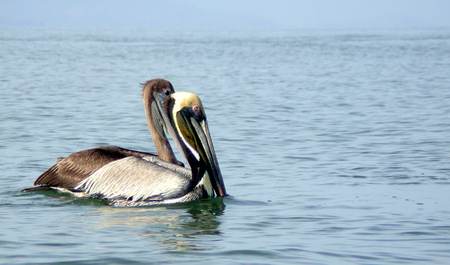
Brown Pelican
Flora & Fauna
Three-wattled Bellbird
Flora & Fauna
Black Witch
Flora & Fauna
Turkey Vulture
Flora & Fauna
Long-tailed Manakin
Flora & Fauna
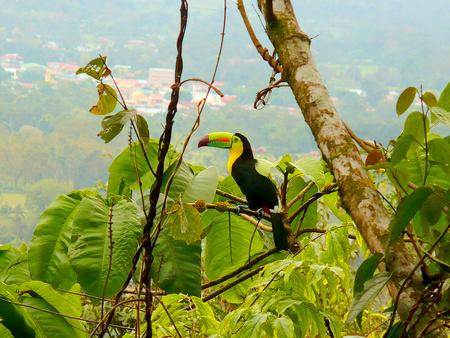
Keel-billed Toucan
Flora & Fauna
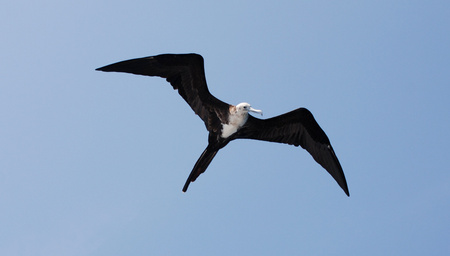
Magnificent Frigatebird
Flora & Fauna
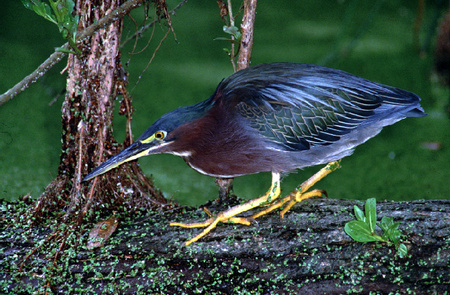
Green Heron
Flora & Fauna
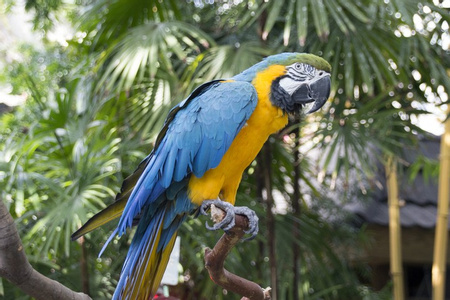
Blue-and-Yellow Macaw
Flora & Fauna
Long-tailed Hermit
Flora & Fauna
Bananaquit
Flora & Fauna

Insider-led Costa Rica Design & Concierge
Your insider team designs the trip around what you care about, then supports you in-country with private logistics, vetted partners, and concierge help when plans change.