

Corcovado National Park
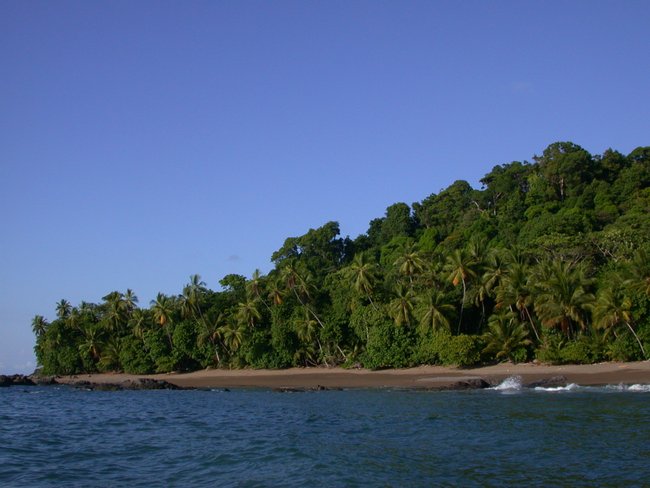
The crown jewel of Costa Rica's national park system, Corcovado National Park (Parque Nacional Corcovado), is comprised of an enormous 103,290 acres (41,800 ha) of tropical rainforest. The largest of Costa Rica's parks, it encompasses about a third of the Osa Peninsula and embraces an unbelievable amount of its biodiversity.
Plan my TripPlanned with a local insider, takes just 2 minutes.
Corcovado Park represents a very diverse population of flora and fauna, including 10% of the mammals found in the Americas. Declared a protected area in 1975 to prevent the harvest of precious resources, it is believed to have the largest concentration of macaws and virgin lowland rainforest in Central America. Also, it is one of the very few locations in Costa Rica that harbor the endangered squirrel monkey (the other most prominent being Manuel Antonio National Park.
As it is one of the most complex freshwater/saltwater ecosystems in the world, Corcovado is home to 500 species of trees, making up one quarter of the tree species in Costa Rica. There are 6,000 species of insects, 140 species of mammals, almost 400 species of birds, 116 species of amphibians and reptiles and 40 species of fish. Some of the most frequently viewed wildlife includes jaguars, four species of sea turtles, anteaters, 220 species of butterflies, sloths, crocodiles, poison-arrow frogs, several species of monkeys, and, with luck, maybe even a tapir. All of the four species of turtles-olive Ridley, leatherback, hawksbill and Pacific green-are known to lay their eggs along the sandy coastal shores. Don't be surprised if you stumble over one!
The park has three main entrances-San Pedrillo to the northwest, Los Patos to the east and La Leona to the south. There are four ranger stations, one at each entrance and one at the park headquarters, Sirena. There is a tiny landing strip in Sirena, which makes it possible to arrive by air through a private charter-making the start of the trip very stress free for explorers. Be sure to allow plenty of time to discover this great park.
It is common for hikers to spend 2-3 days to get from one side of the park to the other, as camping is permitted. Hiking from one ranger station to another is a great way to experience the park and at the same time see Corcovado Lake (Laguna Corcovado), where tapirs are known to frequently stop and get a drink. La Llorona Waterfall (Catarata La Llorona), which plummets 100 ft (30 m) onto the sandy shore along the beach between Sirena and San Pedrillo, is also a popular attraction. Be sure to bring plenty of food and water, insect repellent, sun block and good hiking shoes.
There are muddy, rugged trails that are marked throughout the park. When hiking it is important to be aware of the tide schedule; some spots might be easy to cross during low tide but impossible during high tide. As a word of warning, crocodiles are known to relax in the estuaries and mangroves of rivers so it is crucial to use caution and check in with one of the ranger stations before your voyage into the park. Check ahead of time with the park officials at the headquarters in Puerto Jimenez or at any of the ranger stations to get current information.
The best time to visit is when the park receives the least amount of rain, which is from January to April. From May to December the park receives the most precipitation which can leave some of the trails unrecognizable. Park admittance is $6 per person, per day. By bus or car, Corcovado National Park is approximately 10 hours from San Jose. The park can be accessed from Puerto Jimenez by driving south 27 miles (44 km) along Hwy 245.
Wildlife Sightings
Spotted at Corcovado National Park
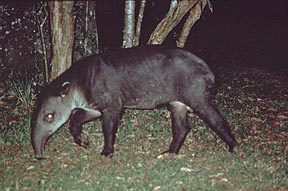
Baird's Tapir
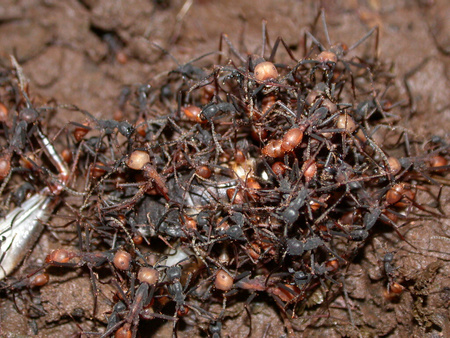
Army Ant
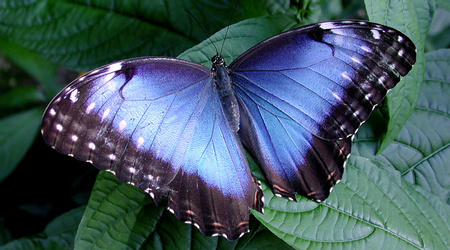
Blue Morpho
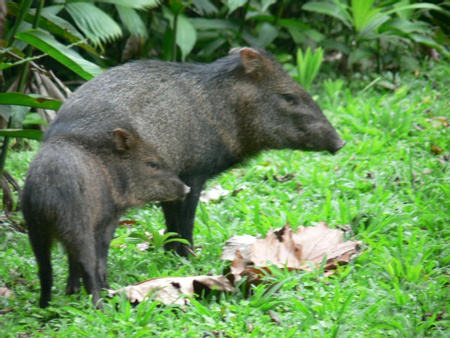
Collared Peccary
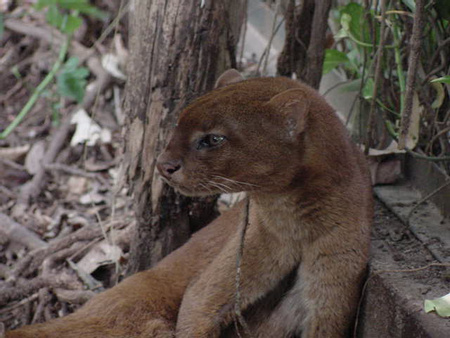
Jaguarundi
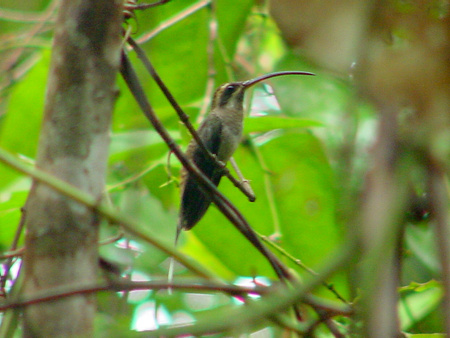
Long-tailed Hermit
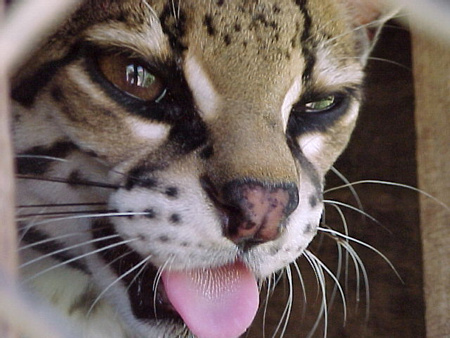
Margay
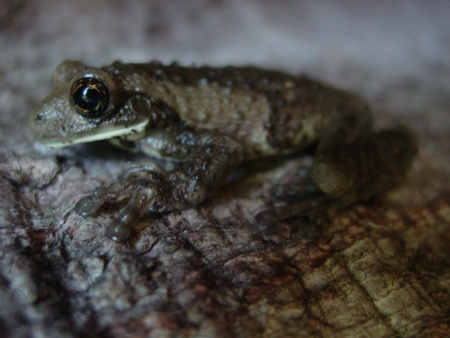
Milk Frog
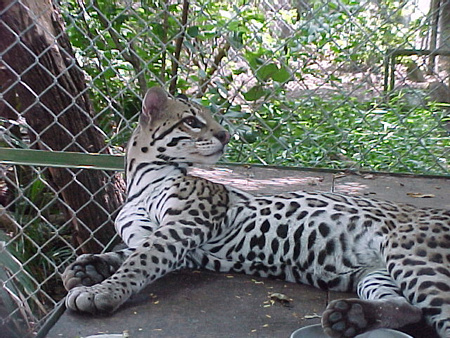
Ocelot
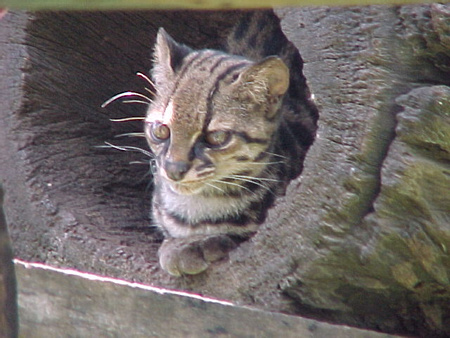
Oncilla
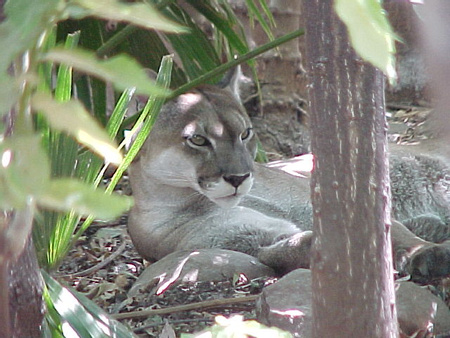
Puma
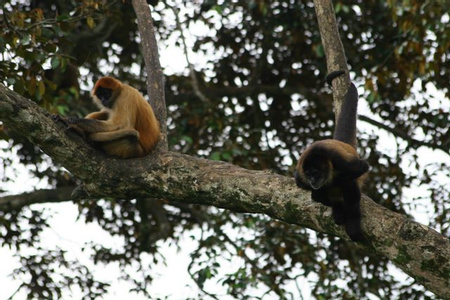
Spider Monkey
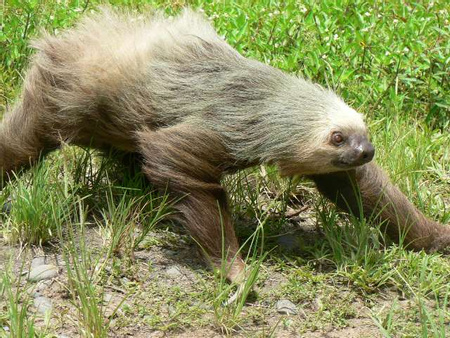
Sloths
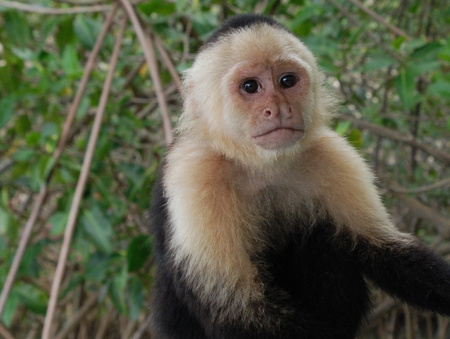
White-faced capuchin monkey
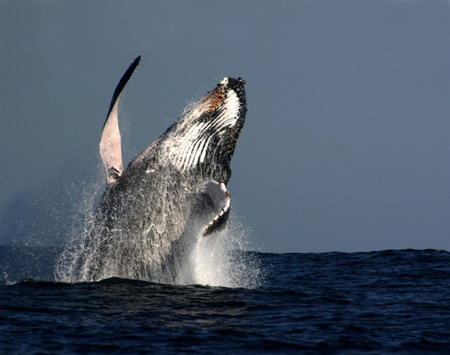
Humpback whale

Sea turtles
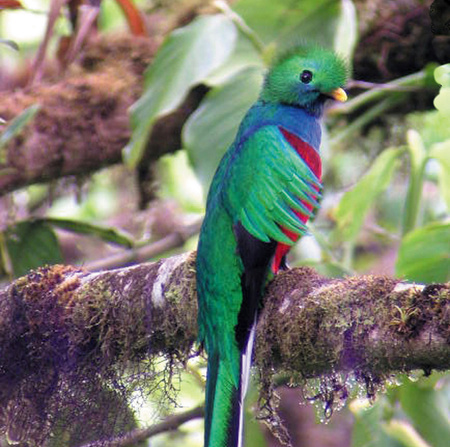
Resplendent quetzal
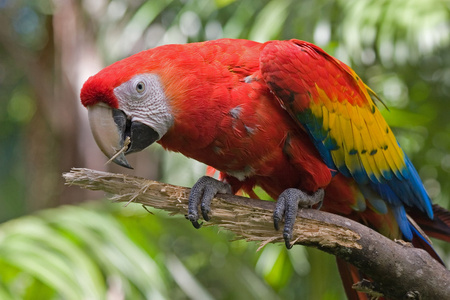
Scarlet macaw
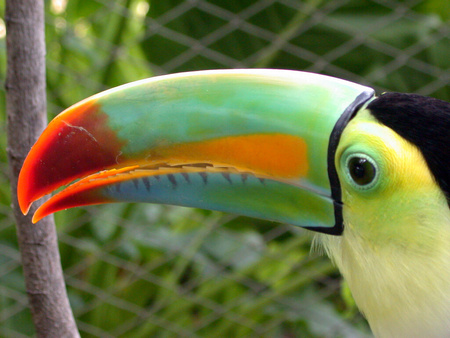
Keel-billed toucan
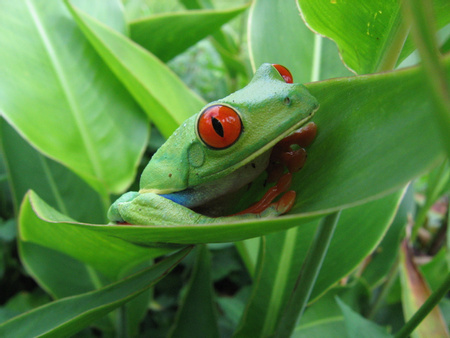
Red-eyed tree frog
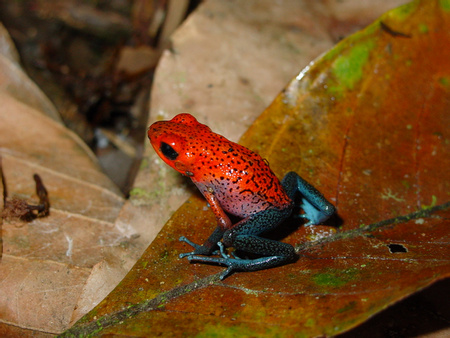
Blue jeans frog

Howler monkey
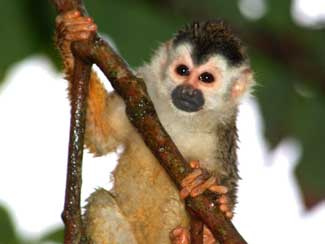
Squirrel monkey
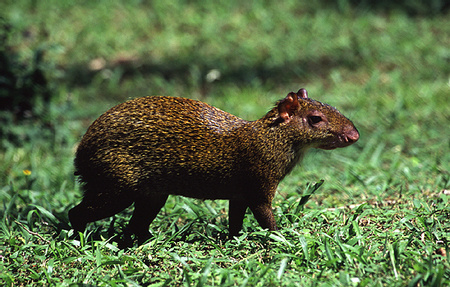
Agouti
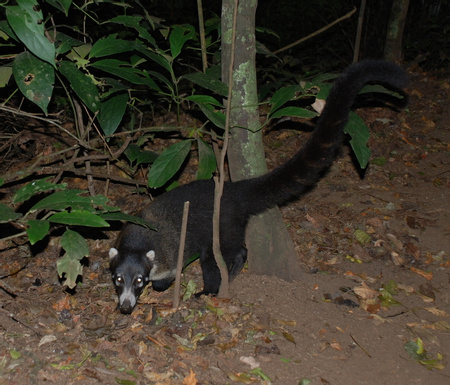
Coati
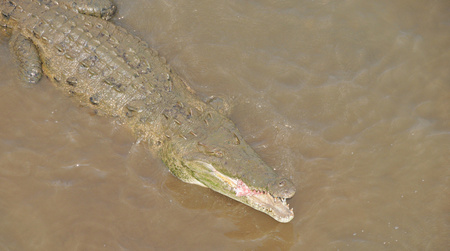
American crocodile
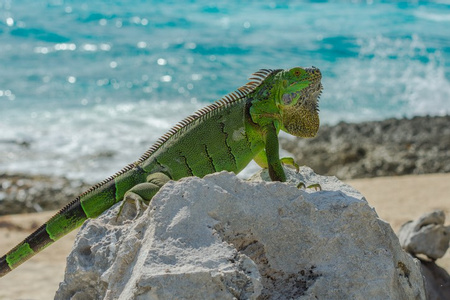
Green iguana
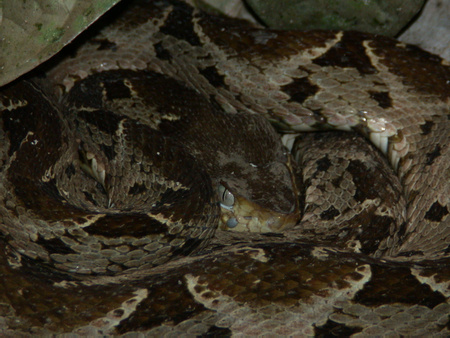
Fer-de-lance
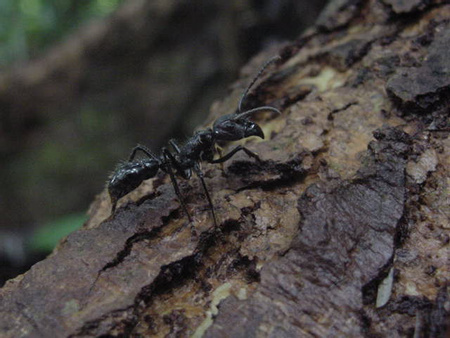
Bullet ant
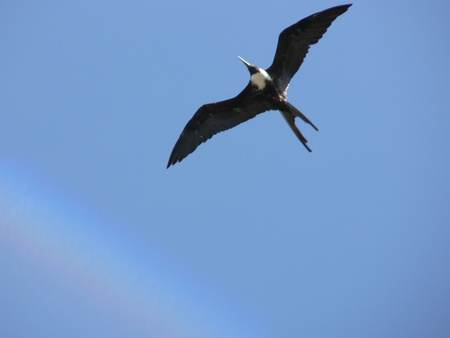
Magnificent frigatebird
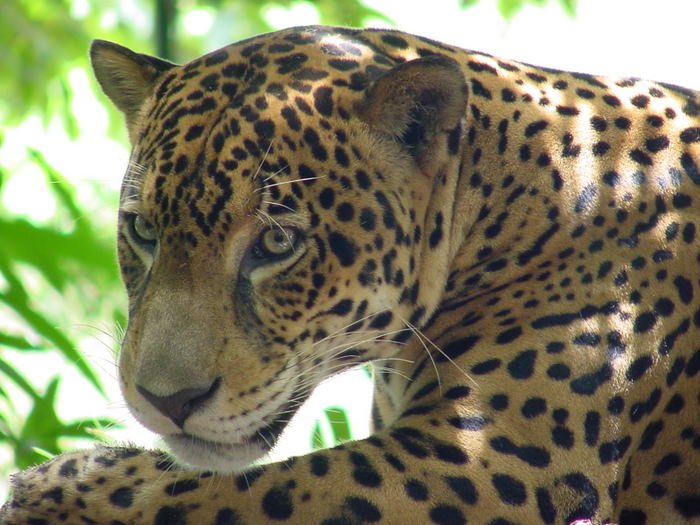
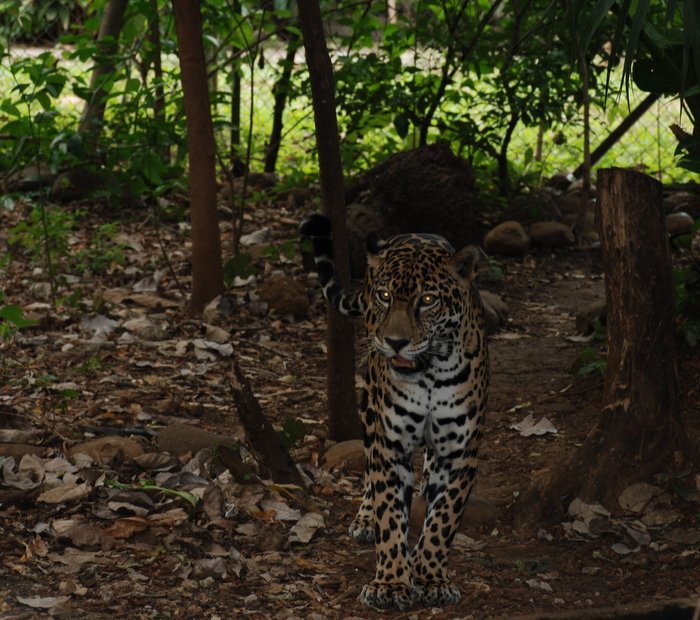
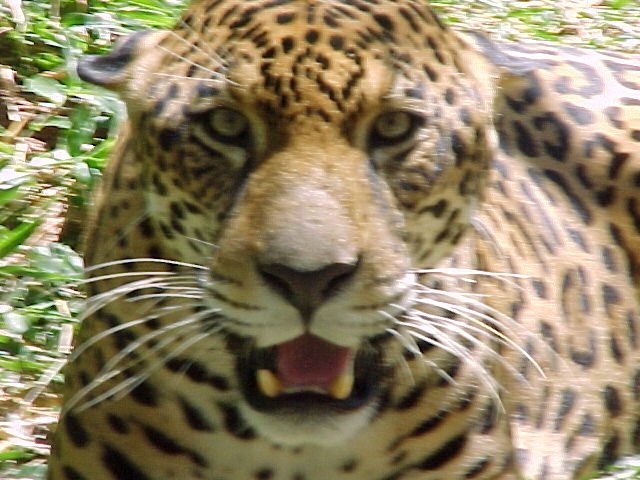
Jaguar
Jaguar (Felis onca). Spanish name: Tigre
Range
In suitable habitats, it lives from northern Mexico to northern Argentina.
Physical Description
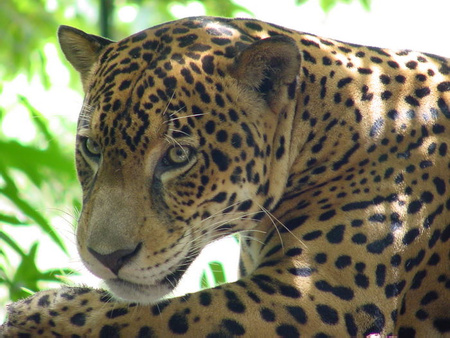
The jaguar has a yellowish brown coat with a white stomach and black spots all over its body. Its tail is short for a large cat – less than half the length of its head and body. This cat is adapted to grip prey with its great head, shoulders and forepaws.
Biology and Natural History
This endangered cat is the largest of Central American carnivores. The jaguar used to be common in many habitats, including mangroves, lowland savannas, wet and dry shrublands and forests up to 1000 m in elevation–but now they are rare except in large protected reserves. Because of the jaguar's conspicuous tracks, the market value of its pelt, its reputation for killing livestock, and its vulnerability to hound pursuit, their numbers and commonality are far reduced today. These cats suffer not only from hunting, but also from habitat destruction. They are sensitive to habitat size: in forest reserves a single male needs several hundred km2 for his home range, and females need somewhat less per individual. Sometimes young males will resort to areas with habitats far from normal for them. But because jaguars require such large territories, even in reserves their numbers do not compare to when they prowled most of Central America.
Jaguars will leave deep scratches on tree trunks, but it is not known whether they use urine or scratches on the ground to mark territories. A strong swimmer, the jaguar is able to cross rivers and other bodies of water. It tends to prefer damp areas like streambeds where footprints betray its presence, size, and whereabouts. The jaguar is mostly nocturnal but sometimes will sun during the day. At night it may roar at any time of year; some hunters call to them with imitations.
Unfortunately for this impressive predator, the jaguar does not seem to avoid the scent of men and may even follow them, although they rarely attack humans unprovoked and do not provide much of a threat to humans. The main threat to current Central America jaguar populations is no longer poaching, but deforestation for the sake of agriculture. Once roads enter a virgin area, jaguars and peccaries are the first large mammals to disappear.
Diet
The jaguar survives on a diverse diet: they prefer peccary, but also eat monkey, agouti, deer, bird, fish, lizard, turtle, or other animals. They've even been known to take sea turtles nesting in Surinam. Mud tracks have also indicated that jaguars will feed on dead fish, alligators, iguanas, or other dead animals beached by receding waters. Occasionally they will kill a domestic animal, but they usually kill and finish a single beast-unlike some other cats, jaguars are not wasteful predators, and even eat the entire ribs of their prey.
Height/Weight
Adult males are 50 to 100 kg, and adult females are two-thirds that size.
Taxonomy
Order: Carnivora
Family: Felidae
Sources
Koford, C. B. in Janzen, Daniel H. Costa Rican Natural History. Chicago: University of Chicago Press, 1983.
Wilson, D. E. in Janzen, Daniel H. Costa Rican Natural History. Chicago: University of Chicago Press, 1983.
-Amy Strieter, Wildlife Writer
Baird's Tapir
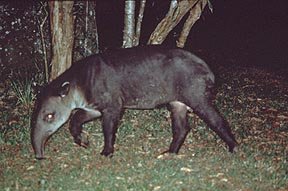
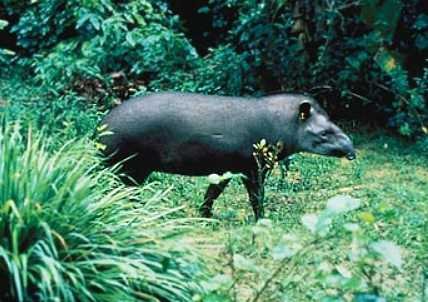
Here’s an animal you don't see everywhere, but you can see it during your vacation —Baird’s Tapir (Tapirus bairdii). Spanish name: Danto, Danta.
Habitat
This tapir survives in dry deciduous forest and tropical evergreen forest and other habitats.
Range
This species of tapir can be found from Veracruz, Mexico down to Ecuador.
Physical Description
Baird's Tapir is the largest of three South American tapir species; there is another tapir in the South America lowlands, Tapirus terrestris; in the mountains of South America resides the smaller, furrier tapir, Tapirus roulinil; one other tapir which is black and white exists in peninsular Malaysia, Tapirus indicus.
Adult tapirs have short sparse black hair over leathery black skin. Their skin is really tough-1 to 3 cm thick! Juveniles will be brown with white spots and stripes. The tapir has a short tail and a long flexible upper lip, with which it picks leaves and pushes food into its mouth.
Biology and Natural History
Tapirs have incredibly strong dentate molars for grinding hard seeds and tough plant material. They are particular about what and how much they eat of certain plants. It has been noticed that tapirs prefer to defecate in water or repeatedly in the same place on land, most likely to reduce their trail to predators.
The endangered tapir is the largest indigenous terrestrial mammal in Central America. Perhaps due to previous heavy hunting, the tapir has become extremely shy, covert, and evasive. Their behavior is crepuscular, meaning they are active at dusk and early morning, but they have also been known to be active at night. They can smell and hear quite acutely, compensating for their poor eyesight. They use routine trails to and from wallowing and feeding sites – which can make them vulnerable to hunters. If they are startled, they can run as fast as a human on their short, powerful legs. Considering their size, they can move surprisingly quietly even over muddy forest floors because their toes come together when they lift up their feet.
The tapir used to be common in all kinds of habitat in Central America; but that all changed once guns were introduced to the area. Now they are mostly found in national parks, and their numbers are still recovering from past hunting.
Adult tapirs live independently except when a female is raising her young. Females have one baby at a time, which stays with her for a year, at which point it will be about two-thirds of her weight. The baby is camouflaged by its spots and stripes so it is safe hiding while it waits for its mother to come back and nurse it. It will start following the mother at 10 days old. Mothers are aggressively defensive of their young, and in the past have attacked humans for this reason. However, they can become docile around other animals. In captivity, peccaries were seen picking ticks off of a tapir and eating them, and coatis have done this to tapirs in the wild as well. Coatis and peccaries perform such mutual grooming in the wild, but the tapir does not. In these observed instances, the tapir did not return the favor, but did not seem to mind their contact, either.
Diet
The tapir mostly eats leaves, twigs, fruits, and some seeds. It is an important disperser of seeds for several plants (e.g., Raphia faedigera).
Height/Weight
An adult tapir weighs 150 to 300 kg.
Taxonomy
Order: Perissodactyla
Family: Tapiridae
Sources
Eisenberg, John. Mammals of the Neotropics, Vol. 1. The University of Chicago Press: Chicago, 1989.
Janzen, Daniel H. Costa Rican Natural History. Chicago: University of Chicago Press, 1983.
Wilson, D. E. in Janzen, Daniel H. Costa Rican Natural History. Chicago: University of Chicago Press, 1983.
-Amy Strieter, Wildlife Writer
Army Ant
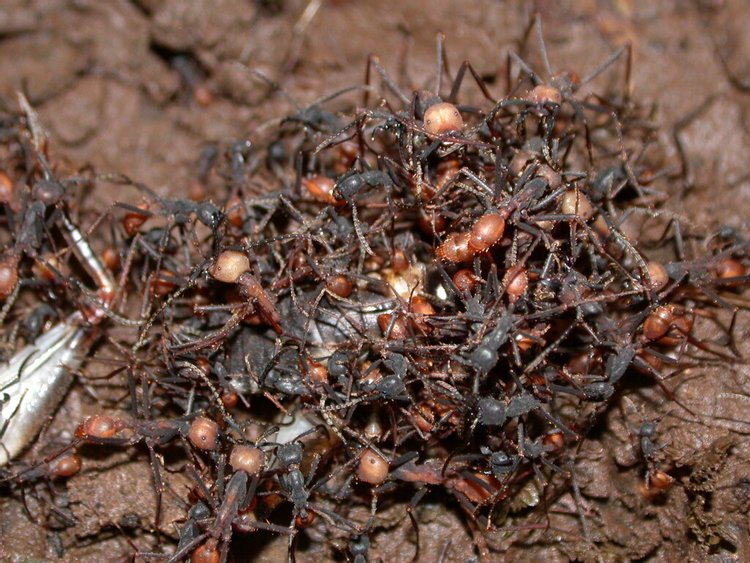
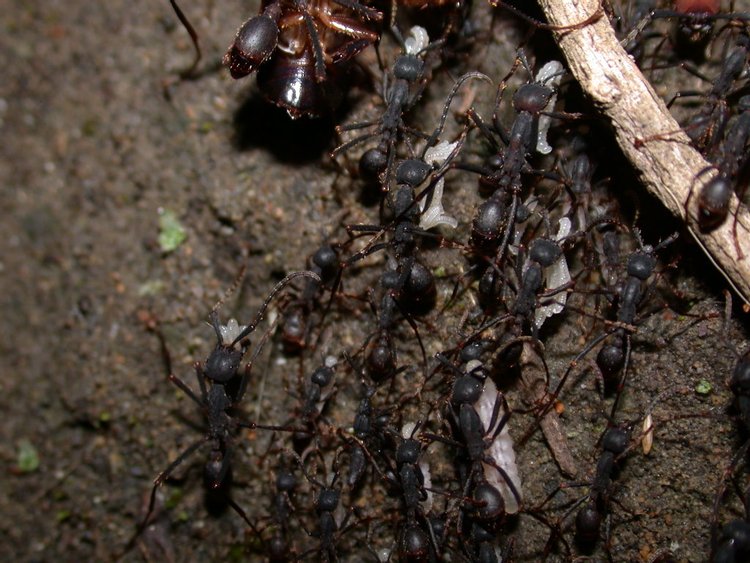
Army Ant (Eciton burchelli). Spanish name: Ronchadores
Habitat
The swarms of this species can be found blanketing forest floors in lowland, premontane, and montane forests.
Range
This fairly common species of army ant is found throughout the Neotropics.
Physical Description
There are approximately 150 species of army ants, but this species is the most famous and has the widest range. Eciton burchelli is black. The queen is drastically different from the other nest members. Males have wings and are born expressly to leave the colony, mate with a queen, and die. The size and proportions of a worker ant are determined by diet when it is young. The soldiers have larger bodies, exaggeratedly gigantic heads, and big hooked mandibles. The smallest workers are 1/5 the size of a soldier and have no mandibles.
Biology and Natural History
These army ants organize breathtaking raids as they cooperatively search for food. Their colonies are composed of the queen, a few males, millions of workers, and young offspring. Instead of building a permanent nest in the ground or in the trees, these army ants make a nest out of their bodies. To form this bivouac, some of the workers hold onto each other to form the walls and chambers of the nest holding the queen, the new eggs, and the developing brood. The colony moves between two stages of behavior, stationary and migratory, which depend on the queen’s reproductive phase. If she is laying new eggs, the colony will find a more protective corner of the forest to keep her safe for about 20 days. If she is done laying eggs for a while, the ants will migrate and set up a new bivouac every night.
Each morning the raid begins when workers leave the bivouac in a column that fans out from the nest. As they move in different directions the ants communicate through pheromones and chemical signals. The columns move continuously over the terrain—trees, rocks, porches, or whatever is in their path become blanketed in ants. Army ants define “food” as anything small enough for them to take down. This fan-shaped force moving among the trees can last much of the day and reach more than 50 m away from the bivouac.
As the raid swarms through the forest, there is a chain reaction on the forest floor. Small arthropods rush away as the army ants race after them, and if crickets or katydids evade the ants, antbirds will snatch them up. These species of birds follow the army ant raids and watch for large, fast insects as well as lizards or frogs to burst out of the leaf litter; these birds never eat the army ants. The antbirds leave droppings as they follow the swarms, and certain butterflies, like the glasswings, follow the antbirds to feed on their droppings.
While it can be imposing to come across these ants in the wild, their hunting parties can be easy to step around. Occasionally a raid column is several meters wide across, and it is important to use care. It can be particularly interesting when the ants begin to raid across a house or building porch. Given a little time, they won’t stay in human dwelling places, but will carry off any bugs they find under the bed. These ants are by no means hunting humans but they should be left alone, as they do bite hard in self-defense. Their mandibles are so strong, that some native cultures have used the ants to suture wounds. After coercing the ant to bite either side of a cut, they would twist off the body and leave the head with the ant’s jaws closed around the injury. Using multiple ants would have a similar effect to stitching the wound.
Diet
The army raid will seek out and capture mostly spiders and insects, such as caterpillars, millipedes, cockroaches, or katydids. The army will attack other ant colonies and wasp nests. Vertebrates with any speed are usually able to escape these arthropod predators, but when given the opportunity the ants will pursue frogs, lizards and snakes.
Height/Weight
The workers of these colonies are the smallest, with a body length of approximately 3 mm. The heartier soldiers can be 9 to 14 mm long. The queen is enormous at several centimeters in length.
Taxonomy
Subfamily: Ecitoninae
Order: Formicidae
Sources
Hogue, Charles L. Latin American Insects and Entomology. University of California Press: Berkely and Los Angeles, 1993.
Kricher, John. A Neotropical Companion: an introduction to the animals, plants, and ecosystems of the New World tropics. Princeton University Press: Princeton, NJ, 1997.
Rettenmeyer, C. W. in Janzen, Daniel H. Costa Rican Natural History. Chicago: University of Chicago Press, 1983.
-Amy Strieter, Wildlife Writer
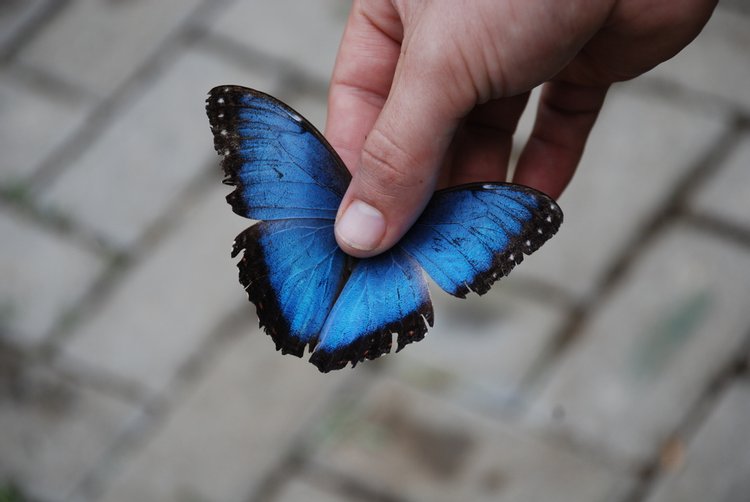
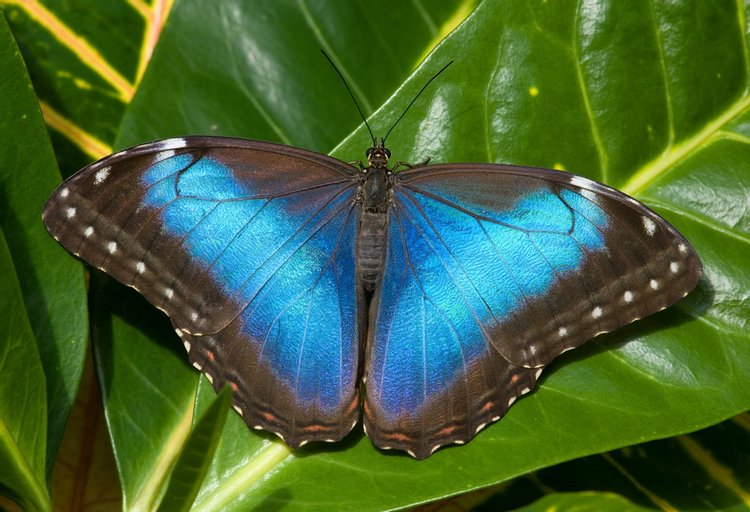
Blue Morpho
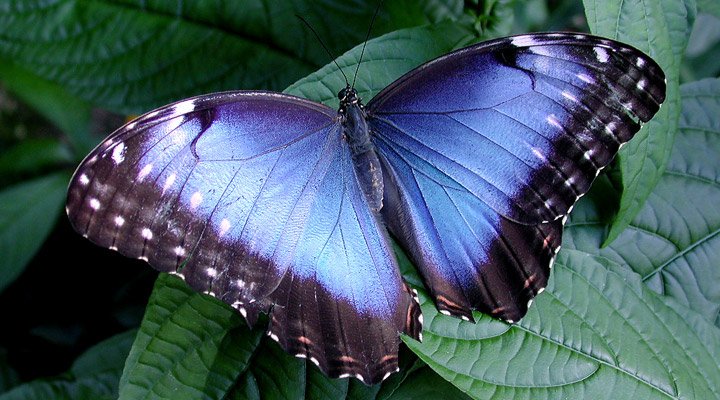
Blue Morpho (Morpho peleides). Spanish name: Morfo
Habitat and range
This adaptive butterfly is most often spotted along habitat edges—of forest, field, river, or ocean. From sea level to 1,800 m in elevation, the morpho lives as far north as Mexico and as south as Venezuela, Colombia and Ecuador.
Physical Description
Visitors struggle to find words for this mesmerizing butterfly, and strive harder to catch a photo of the effulgent blue tucked inside the morpho’s wings. The morpho has a characteristic float-and-fall flight pattern, rising and dipping lazily along rivers, coastlines, forest edges, and agricultural fields. The blue upper surface of the wings interchanges with the chocolate brown underside, making the morpho difficult to track both physically and visually. This coloration strategy is referred to as “flash and dazzle” because it may cause the predator to hesitate out of confusion. When the morpho feels threatened, its flight turns erratic, looping and diving away from a pursuer. Most frustrating to the friendly photographer, the morpho keeps its wings closed when it sits on a branch or a piece of fruit. The iridescent blue may stay open longer in the sun or as the butterfly ages, but this is unpredictable.
Different species of morpho show a variety of color schemes, although most have the characteristic metallic coloration. Within the Morpho genus, adult colors range from a shocking pearly white to a lighter blue to a heavier violet shade of blue. Some species have the black border around the wings that this particular species has, but others have a paler edge color or none at all. Females are generally less colorful than the males.
Biology and Natural History
The most common butterfly in Central America, this species receives favoritism by visitors and locals alike. Morpho butterfly wings are particularly brilliant because the color is due to structure, as opposed to pigment. The wing scales are constructed so they refract light in such a way that the blue is always bright. This color does not fade. The scales can, however, get rubbed off as the butterfly ages, knocks between leaves, and narrowly misses a bird’s beak or lizard’s mouth.
For this species of morpho, males look for food earlier in the morning and females come out several hours later. Depending on the species or subspecies of morpho, the peak hours of activity may be earlier or later. Upon finding a meal of juicy rotting fruit, the morpho will feed with its wings closed. The large dark ocelli on the wing undersides will help it blend in with the surrounding forest. These ocelli resemble eyes too large for an insect, and may startle a potential predator as it approaches the morpho.
Morphos are not always bright and shiny, though. Females lay eggs on host plants that hatched caterpillars can digest. These eggs are tiny and nondescript, and the caterpillars that emerge begin eating immediately. Younger caterpillars are brown with tufts of bright red and yellow hair. By their last few molts, they are still fuzzy, but entirely brown, fat, and well camouflaged against the bark of their host plants. When it is time to pupate, the caterpillar will hang upside down from a branch, wait approximately two days, and then begin the final molt. The pupa is green and ovoid, resembling a leaf bud. After 3 weeks the butterfly emerges one morning and waits for its wings to dry before taking flight and revealing its bright blue for the first time.
Diet
As an adult, the morpho favors the juices of rotting fruit or fungal growths. As a caterpillar, it munches through leaves of host plants from the family Fabaceae, including Mucuna, Macharium, and Longchocarpus.
Height/Weight
Wingspan for a blue morpho is 20 cm.
Taxonomy
Order: Lepidoptera
Family: Nymphalidae
Sources
DeVries, Philip J. The Butterflies of Costa Rica and Their Natural History: Papilionidae, Pieridae and Nymphalidae. Princeton, NJ: Princeton University Press, 1987.
Goode, Mark R. An Introduction to Costa Rican Butterflies. San José, Costa Rica. 1999. ISBN 9977-12-365-9.
Hogue, Charles L. Latin American Insects and Entomology. University of California Press: Berkely and Los Angeles, 1993.
Kricher, John. A Neotropical Companion: an introduction to the animals, plants, and ecosystems of the New World tropics. Princeton University Press: Princeton, NJ, 1997.
-Amy Strieter, Wildlife Writer
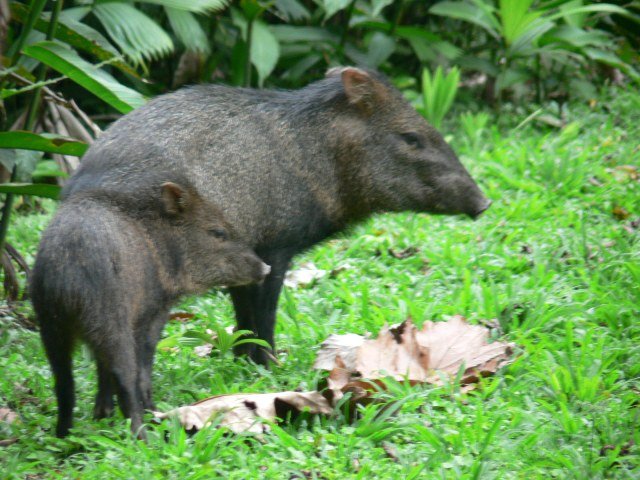
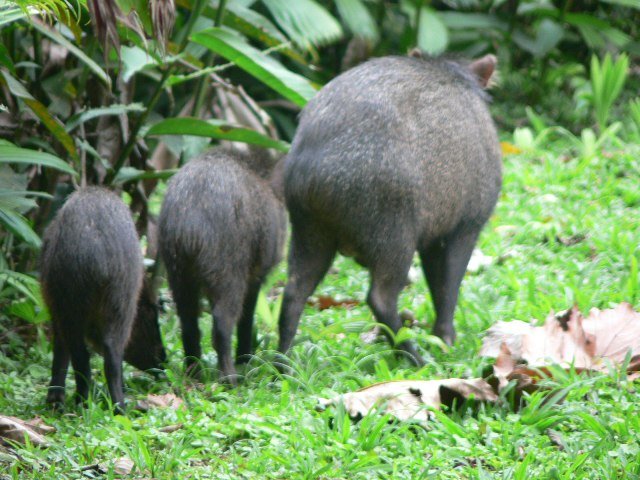
Collared Peccary
Collared Peccary (Tayassu tajacu). Spanish name: Saino
Habitat Resourceful and versatile in many habitats, this peccary can survive in tropical rain forest, tropical deciduous forest, semidesert land, scrub forest, and some agricultural areas (where they are considered pests).
Range
Of North American ungulates, the collared peccary has one of the largest ranges, including from Arizona, New Mexico, and Texas down to Rio Plata in Argentina.
Physical Description
Peccaries are hunted for food and their marketable skin. When born, peccaries are reddish brown, but by adulthood they have gray-black skin covered in coarse hair that can be as long as 15.2 cm on the back. A distinct white strip around the neck makes them easily identified as "collared.'
Biology and Natural History
The peccary is very social and keeps hierarchical herds of three to thirty or more. Individuals within these groups sleep next to each other to keep warm, and are cohesive in their actions in general. Friendlier individuals rub each other, especially in greeting: each will rub its head against the scent gland on the back of the other. Peccaries make several vocalizations, including a loud bark, aggressive grumblings (especially when feeding in groups), warning tooth chattering, and purring. They may have aggressive disputes over watering holes in deciduous forests in the dry season.
Diet
In general, peccaries are not picky foragers. Peccaries eat a variety of roots, tubers, bulbs, fruits, palm nuts, and rhizomes; in agricultural areas they may also eat crops. In the rainy season, they tend to eat more leafy foliage.
Height/Weight
Central American peccaries weigh about 19.3 kg, smaller than North American peccaries. In Arizona, adults are (approximately) 14 to 27 kg and 46 to 56 cm tall at the shoulder and 89 to 97 cm long.
Taxonomy
Order: Artiodactyla
Family: Tayassidae
Sources
Eisenberg, John. Mammals of the Neotropics, Vol. 1. The University of Chicago Press: Chicago, 1989.
Sowls, L. K. in Janzen, Daniel H. Costa Rican Natural History. Chicago: University of Chicago Press, 1983.
Wilson, D. E. in Janzen, Daniel H. Costa Rican Natural History. Chicago: University of Chicago Press, 1983.
Amy Strieter, Wildlife Writer
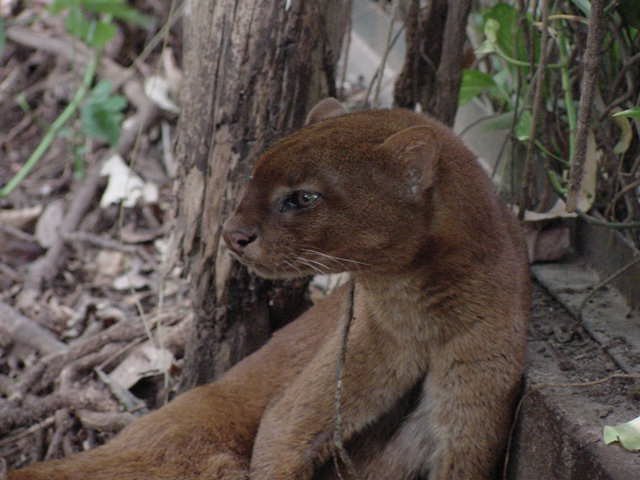
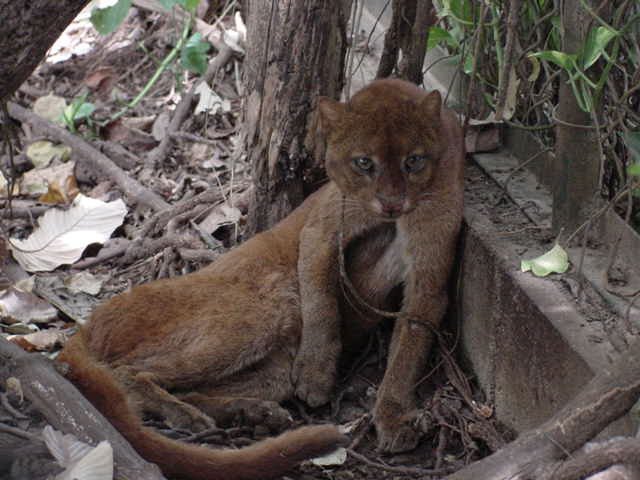
Jaguarundi
Jaguarundi (Herpailurus yagouaroundi). Spanish name: Gato Moro
Habitat
This cat tolerates many different habitats, including gallery forest, tropical evergreen forest, and dry deciduous forest.
Range
The Jaguarundi lives between the Rio Grande Valley in Texas to northern Argentina.
Physical Description
Unlike most other cats in Central America, the Jaguarundi is very diurnal, and has a circular pupil probably for this reason. Its face looks somewhat ominous compared to other cats because of its unusual eyes, body proportions, and coat color. It is a medium-sized cat with a slender build and comparatively long neck and head. Unlike other small cats in Central America, the Jaguarondi is not spotted, and is instead a solid black, gray, or reddish color. This feline is also unusual for its range because it is more likely to be aggressive or mean when encountered, while other cats tend to evade confrontation.
Biology and Natural History
Two or more individuals are often seen traveling together, presumably a mother with her offspring. She will have two or more young at a time in a den in a hollow log, treefall, or thicket. Although the jaguarundi sleeps and hunts on the ground, it capable of climbing trees. This cat is active in the early morning and late afternoon, and often treads dense underbrush near water, valley forests, boundaries of gallery forests, or secondary forest by villages. Again an irregularity, this cat does not necessarily avoid settled areas, and is known to take chickens. Despite this and its daylight hunting, this is still a stealthy cat, uncommonly seen, and mostly glimpsed by field workers because of its hours of activity.
Diet
The Jaguarundi is particularly skilled at hunting small rodents, rabbits, and ground-nesting birds; it may also take lizards and chickens.
Height/Weight
An adult generally has a head and body length of 0.76 to 0.82 m, and a tail 0.32 to 0.506 m long. They weigh about 9 kg.
Taxonomy
Order: Carnivora
Family: Felidae
Sources
Eisenberg, John. Mammals of the Neotropics, Vol. 1. The University of Chicago Press: Chicago, 1989.
Emmons, Louise H. Neotropical Rainforest Mammals: A Field Guide, 2nd Ed. University of Chicago Press: Chicago, 1990.
Wilson, D. E. in Janzen, Daniel H. Costa Rican Natural History. Chicago: University of Chicago Press, 1983.
-Amy Strieter, Wildlife Writer
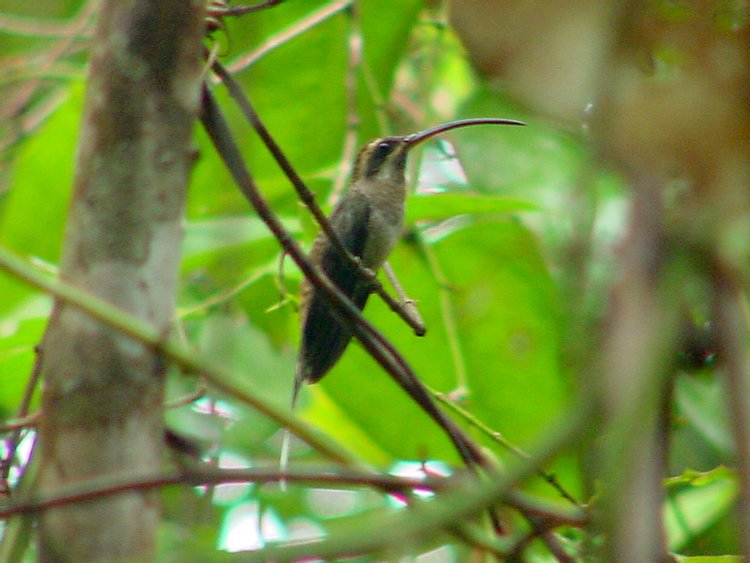
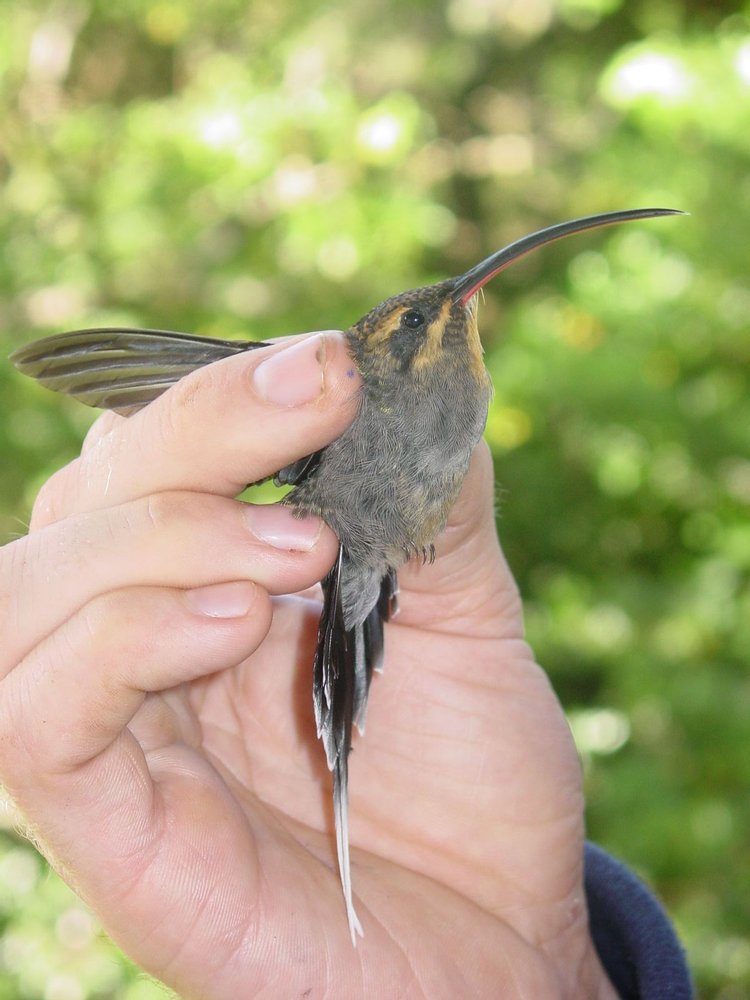
Long-tailed Hermit
Long-tailed Hermit (Phaethornis superciliosus). Spanish name: Ermitano Colilargo, Gorrion
Habitat
In wet lowland forests this hummingbird is active in the understory, light gaps, forest edge, and old second growth. It commonly lives at elevations as high as 1,000 m, but above this elevation the Long-tailed is replaced by the Green Hermit, which is similar in biology and habitat choice.
Range
The Long-tailed Hermit can be found between southern Mexico and central Brazil.
Physical Description
A curious, assertive little bird with an extraordinarily long, curved bill may materialize before visitors in tropical forests; it hovers until it feels threatened, then squeaks and darts off as abruptly as it appeared.
Other hermits share the distinct bill and some also have the extended tail feathers. The bill of this species is 3.5 to 4 cm, which is almost one-third its body length, and its long tail feathers are half as long as the rest of its body. The medium-sized Long-tailed Hermit has dull plumage compared to other hummingbirds, but this is no eyesore. With bronzy green feathers on its back, from a darker brown head to a more tawny lower body and a brownish grey belly and breast, the Long-tailed wears many colors. It has clear white stripes above and below the eye. The upper mandible is black, and the lower is a dull orange-when this bird opens its mouth, the shocking orange lining may intimidate an attacker or competitor. Females are colored the same as males, but are smaller.
Interesting Biology
Hermit hummingbirds are solitary wanderers, traveling far through the understory searching for nectar. The Long-tailed Hermit is adapted to follow and adjust to the changing rhythms of flower availability. They also feed at flowers from which they exclusively can access the nectar with their specially-shaped bills. At other flowers the hermit may be thwarted by smaller, more aggressive hummingbirds. These smaller species do not try to feed at the hermit's favorite flowers. To find enough nectar in a day, the hermit follows traplines, or routes that cover multiple potential food sources; the hermit's traplines may be 1 km long (although routes of 300 to 500 m are more common). The flowers which the hermit favors tend to grow along stream edges in tall second growth or the forest understory, so this bird is often seen in such places.
Males of this species court females using a lek system: approximately 12 males (as few as 3 to as many as 25) gather in a dense thicket, often near a stream; each male stakes out a territory and sings from his different perches within it. The males vocalize single-note songs, challenge each other, and track the others according to their songs. Long-tailed Hermits begin lekking when heliconia flowers are abundantly bursting into bloom (the most intense period is May and June). Females come to the lek to breed, then perform all subsequent parent duties alone, which frees males to invest so much energy in lekking.
For a nest, the mother will construct a tightly woven cup bound with spider web to the underside of a leaf tip on a palm, banana plant, or heliconia. This keeps the nest safe from rain. To protect the young from predators, she intentionally attaches a "tail' of dead leaves to disguise the nest as understory debris. Even with such an effort, very few offspring survive to adulthood: 75 to 80% nests of this species fail due to predation. With such a mortality rate, the Long-tailed Hermit needs a longer breeding season of 9 months, during which it nests 2 to 3 times.
Diet
The favored species of flower for this bird are Heliconia, Passiflora vitifolia, Costus, and Aphelandra. They may also pick spiders or insects from webs or vegetation.
Height/Weight
Adults of this species are generally 15 cm long and weigh 6 g; the males tend to be larger.
Brief Taxonomy
Order: Apodiformes
Family: Trochilidae
Sources
Skutch, Alexander F. and F. Gary Stiles. A Guide to the Birds of Costa Rica. Utica: Cornell University Press,1989.
Stiles, F. G. in: Janzen, Daniel H. Costa Rican Natural History. Chicago: University of Chicago Press, 1983.
-Amy Strieter, Wildlife Writer
Margay
Margay (Felis wiedii). Spanish name: Tigrillo, Caucel
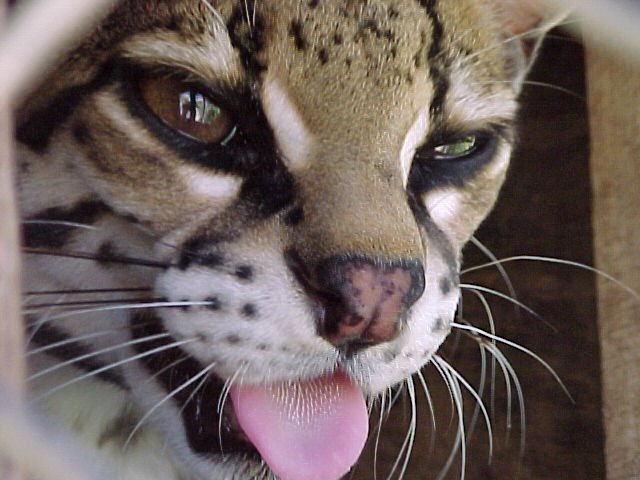
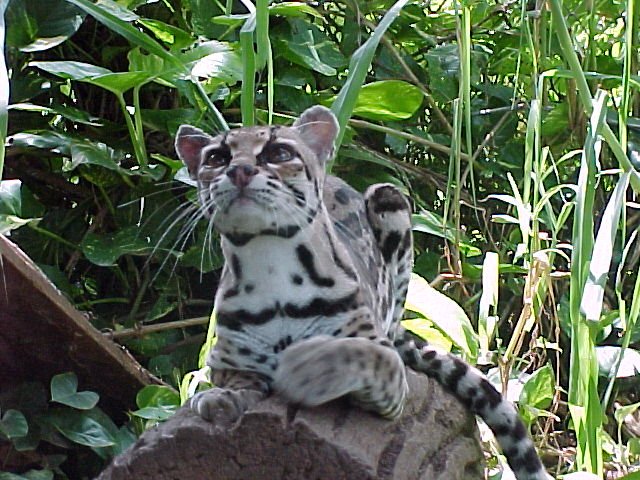
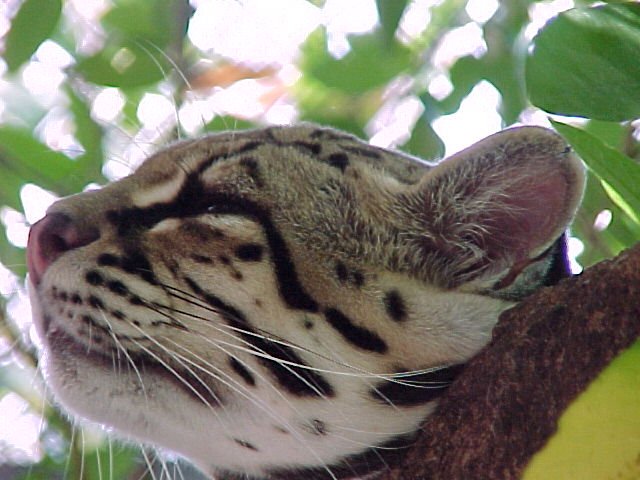
Habitat
The margay lives in thick forests up to and above 3,000 m in elevation.
Range
This cat survives from Mexico to northern Argentina.
Physical Description
Adults are about the size of a large house cat and have a tail more than half the length of their head and body; their front and hind feet are about the same size. The ocelot has larger forefeet and a shorter tail for its size. The margay and ocelot are different from other Neotropical cats in that the hair on the back of the head and nape slants forward. These two cats have open spots outlined in black, but on the sides of the ocelot these spots form bands. Occasionally there will also be a black margay.
Biology and Natural History
This endangered spotted cat used to be widespread in Central America, in thick woods from coastal lowlands to interior mountains. Because it has a small pelt, it was not hunted as voraciously as the ocelot, but its habitat has been extensively deforested for banana groves and pastures. Margays refuse to live in open areas, and now are confined to forested reserves up to and above 3,000 m in elevation
Of all Neotropical cats, the margay is the most adept at climbing trees. Ocelots are also skilled climbers, and both of these cats sleep in trees and make nests in hollows. The margay, like the ocelot, marks branches or other objects with urine. The margay is more nocturnal and solitary than the ocelot, which may travel in pairs and live in groups in captivity. Margays have one or two young to a litter, and these cats do not breed well in captivity.
Diet
Margays prey on monkeys, rodents, birds, lizards, and insects; sometimes they will raid chicken coops. One individual in Santa Rosa National Park tried attacking a porcupine; it left well-pricked and unsatisfied.
Height/Weight
Margay adults weigh 3 to 5 kg; their feet are up to 5 cm across the toes.
Taxonomy
Order: Carnivora
Family: Felidae
Sources
Koford, C. B. in Janzen, Daniel H. Costa Rican Natural History. Chicago: University of Chicago Press, 1983.
Wilson, D. E. in Janzen, Daniel H. Costa Rican Natural History. Chicago: University of Chicago Press, 1983.
Amy Strieter, Wildlife Writer
Milk Frog
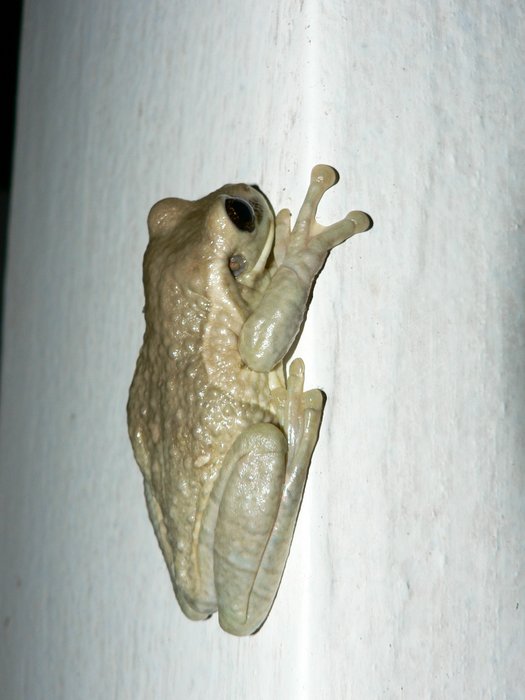
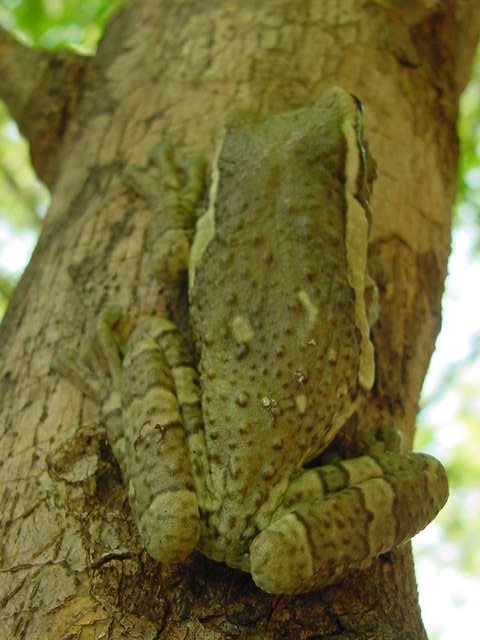
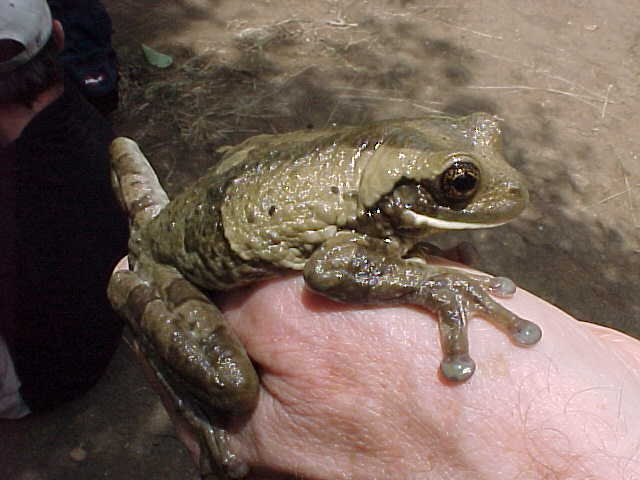
Milk Frog (Phrynohyas venulosa). Spanish name: Rana lechosa
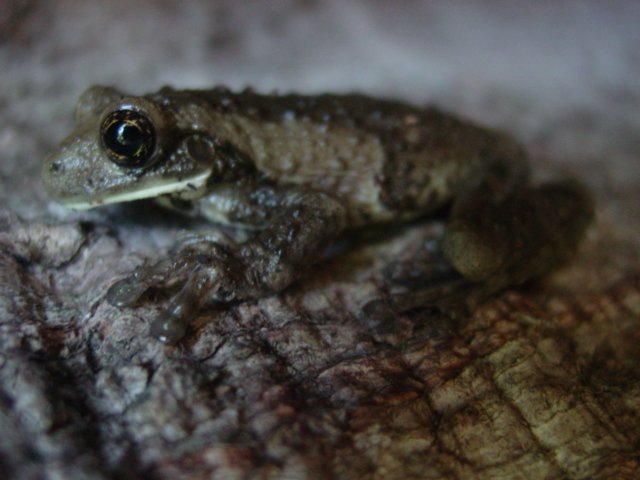
Habitat
In lowland dry to moist or wet forests, the milk frog can be found around ponds at the beginning of the wet season. In the dry season, it hides in cooler, humid corners such as in bromeliads, under tree bark or in tree holes, or wedged in banana or Heliconia plants.
Range
Its full range spreads on the Pacific slope from southern Mexico to eastern Panama and on the Atlantic side down to northern Nicaragua. The frog also lives from western Ecuador through Venezuela, northeastern Brazil, and northern Argentina.
Physical Description
The milk frog is one of the largest of all tree frogs in Central America. Holding with its kind, its hands and feet are webbed and equipped with large round finger disks that are adhesive to help it grip slippery plant surfaces. The upper skin may be one of a variety of lighter colors, from red to yellow to brown to gray or tan; over this base color may be large darker splotches outlined in dark brown or black. The pale belly is covered in fine, grainy skin.
The milk frog has attractive eyes, large and dark gold speckled with black and a horizontal pupil. Adult males can look more surprising—when calling, they inflate vocal sacs on either side of their head that can jut far out from the face. These sacs start behind the jaw and are visible even when deflated.
Biology and Natural History
During the day in the dry season this frog is more difficult to find as it hides in bromeliads or hollow parts of trees. In the rainy season it is more commonly found near temporary pools. This arboreal frog emerges at night from its hiding places to look for food. As other tree frogs, the milk frog can parachute from higher branches down to lower leaves by spreading out its limbs and webbing.
The large extended vocal sacs are used to call in a loud, nasal growl that some liken to a bull roar. Males will start to call as they sit or float in shallow waters created by the first rains of the wet season. The vocal sacs are so large that they help the males float in large aggregations at dusk as they wait for females to approach. An ‘explosive breeder’ species, the milk frogs will only mate and lay eggs on a few rainy nights each year. When a female makes her choice, the pair will mate in shallow water. The eggs float on top of the water in a single layer and can cover an area of 1.5 m2; they float until the tadpoles emerge after 37 to 47 days.
The milk frog is named for the important milky, toxic mucous that releases from the frog’s thick skin when it feels threatened. Copious amounts of the sticky, white secretion help protect the frog from predators as well as dehydration. In South America, some milk frogs line their tree holes with this film during the dry season to survive. While this striking frog may be tempting, handling is not recommended; the noxious secretion causes painful burning or swelling to the skin and can be worse if it contacts the eyes.
Diet
This frog hunts nocturnal insects.
Height/Weight
At its largest, a male milk frog will reach 100 mm (or 4 in.). Females can be 114 mm (4.5 in.) long.
Taxonomy
Order: Anura
Family: Hylidae
Sources
Leenders, Twan. A Guide to Amphibians and Reptiles of Costa Rica. Zona Tropical, S.A, Miami, FL, 2001.
Savage, Jay M. The Amphibians and Reptiles of Costa Rica: A Herpetofauna between two Continents, between Two Seas. The University of Chicago Press, Chicago, 2002.
Savage, J. M., N. J. Scott, and D. C. Robinson in: Janzen, Daniel H. Costa Rican Natural History. Chicago: University of Chicago Press, 1983.
-Amy Strieter, Wildlife Writer
Ocelot
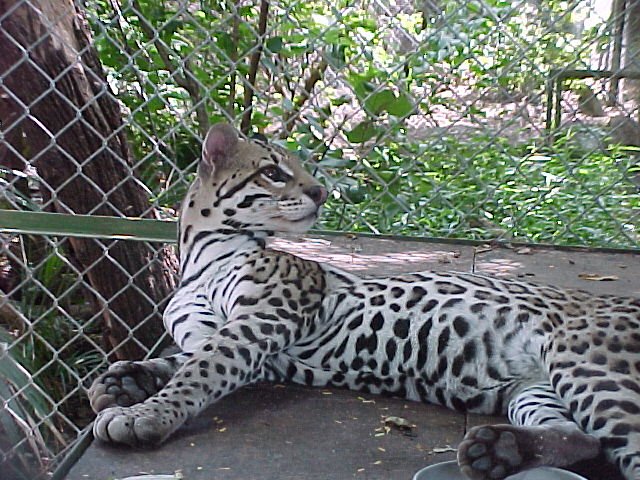
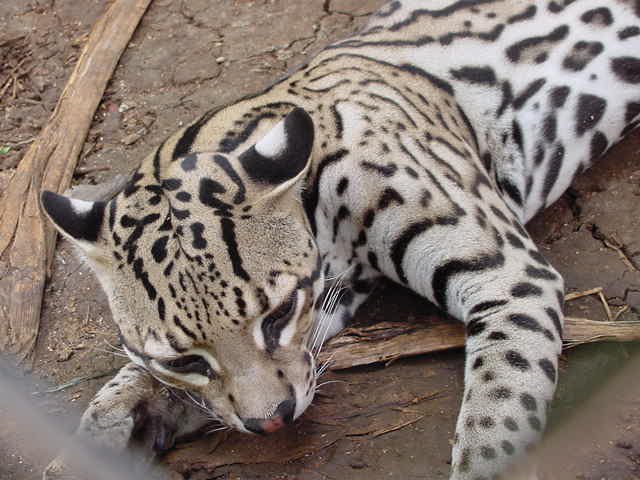
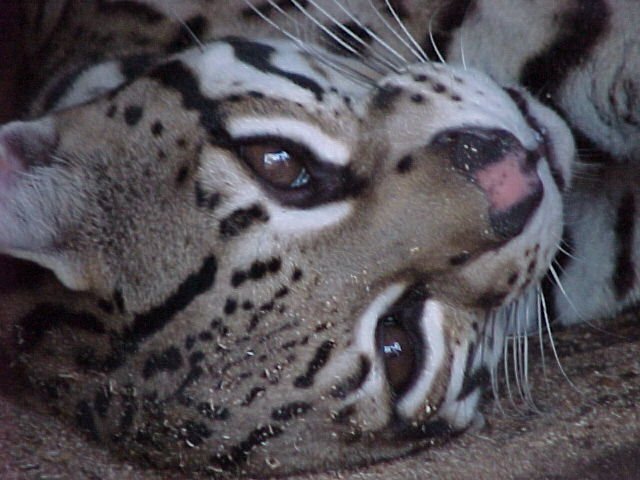
Ocelot (Leopardus pardalis) Manigordo
Habitat
Well adapted to dry deciduous forest, primary or secondary rainforests, and valleys.
Range
This cat has a wide range, from southern Texas to Argentina; they are usually found below elevations of 1,200 m.
Physical Description
Its massive feet grant it the Spanish name mano gordo (literally translated, "fat hand'). These feet also make this cat well adapted to tree climbing and may sleep in trees or use them to cross a stream. The base color of its coat can be grayish to cinnamon, with black spots that form streaks on the neck or elongated spots on the body. Its tail is marked with incomplete bands. Each individual has a unique coat pattern.
Biology and Natural History
This cat is very secretive, and is not usually seen; but its populations have also been devastated in the past by the fur trade. During the 1980s, 133,000 pelts were sent every year to the United States alone. Now it is illegal to import spotted furs to the US, but the ocelot is still faced with another formidable foe: extensive habitat destruction. This cat can live wherever there is sufficient vegetation cover and prey, and they are very opportunistic feeders. But without some sort of cover, they cannot hunt or live; they are rarely found far from vegetative cover.
The ocelot moves and hunts alone. The territory of an adult male may have a total area of up to 17 km2, overlapping several smaller female territories which may be approximately 15 km2. Females can have up to 4 young to a litter, but having 1 or 2 is more likely. She raises them in a secluded place. These beautiful cats are nocturnal, and sleep in trees during the day.
Diet
The ocelot hunts prey from small rodents to iguanas and peccaries.
Height/Weight
This cat has a head and body length of 0.7 to 0.9 m, and a tail of 0.28 to 0.4 m. Females are slightly smaller than males. Adults weigh about 13 kg.
Taxonomy
Order: Carnivora
Felidae: Felidae
Sources
Eisenberg, John. Mammals of the Neotropics, Vol. 1. The University of Chicago Press: Chicago, 1989.
Emmons, Louise H. Neotropical Rainforest Mammals: A Field Guide, 2nd Ed. University of Chicago Press: Chicago, 1990.
Koford, C. B. in Janzen, Daniel H. Costa Rican Natural History. Chicago: University of Chicago Press, 1983.
Wilson, D. E. in Janzen, Daniel H. Costa Rican Natural History. Chicago: University of Chicago Press, 1983.
Amy Strieter, Wildlife Writer
Oncilla
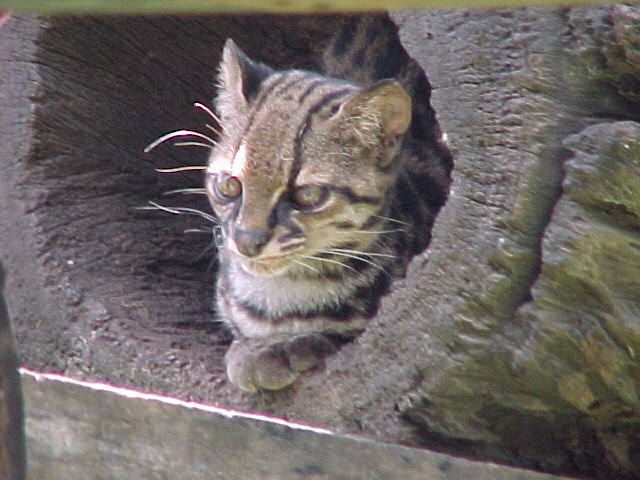
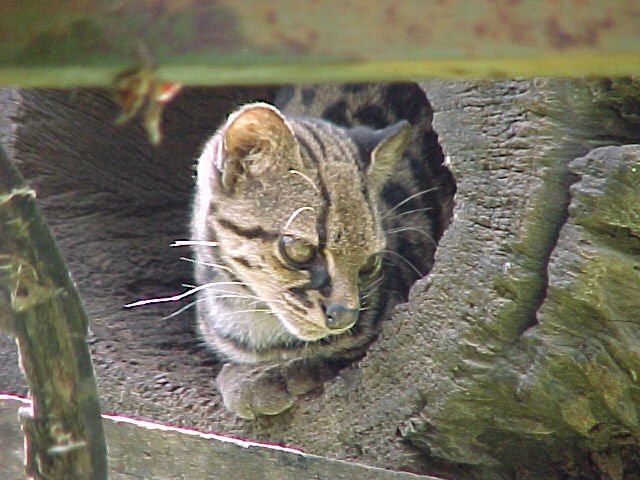
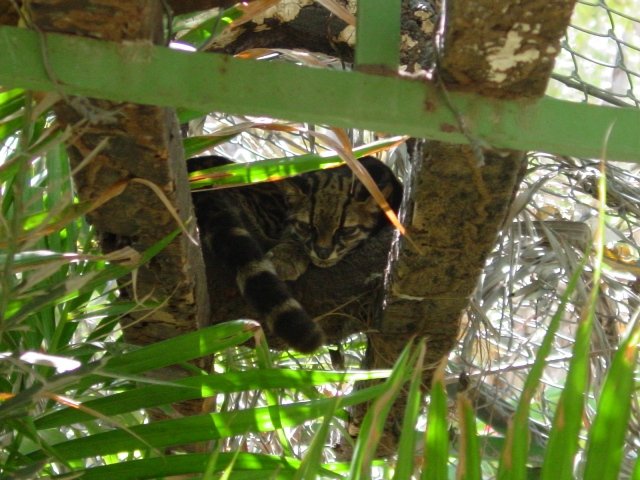
Oncilla (Leopardus tigrinus). Spanish name: Caucel
Habitat
This wild cat lives commonly in premontane forests as well as lowland forests, and may also be found in some cloud forests.
Range
The oncilla spans from Costa Rica across northern South America to Brazil.
Biology and Natural History
Also known as the "Little Spotted Cat,' the oncilla is so named because it is one of the smallest wild cats in the neotropics. It is usually a pale color with closed black spots and two pairs of strong black strips on the sides of the neck, but in some parts of northern Venezuela, all-black individuals may be found. This small cat is nocturnal and terrestrial, focusing on small prey. It is very shy and solitary, and because its tracks are almost identical to a domestic cat's, it can go rather anonymously about its hunting if humans live in the area. Females will have one or two kittens at a time.
Diet
The oncilla mostly preys on birds and small rodents.
Height/Weight
Adults have a head and body length of 34-56 cm, and a tail length of 19.8-22 mm; they weight 1.5-3 kg.
Taxonomy
Order: Carnivora
Family: Felidae
Sources
Eisenberg, John. Mammals of the Neotropics, Vol. 1. The University of Chicago Press: Chicago, 1989.
Koford, C. B. in Janzen, Daniel H. Costa Rican Natural History. Chicago: University of Chicago Press, 1983.
Wilson, D. E. in Janzen, Daniel H. Costa Rican Natural History. Chicago: University of Chicago Press, 1983.
-Amy Strieter, Wildlife Writer
Puma
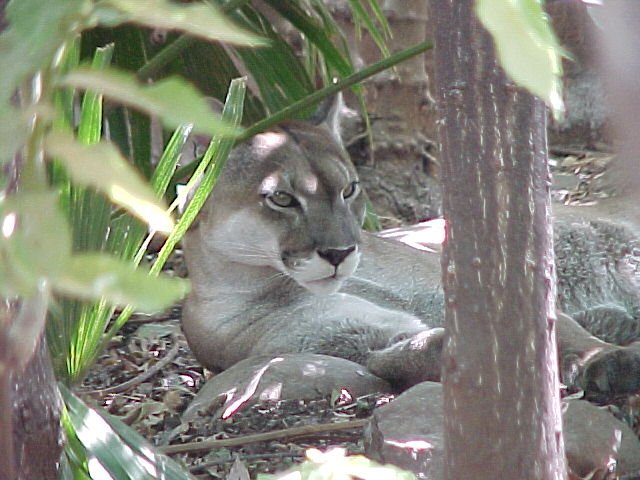
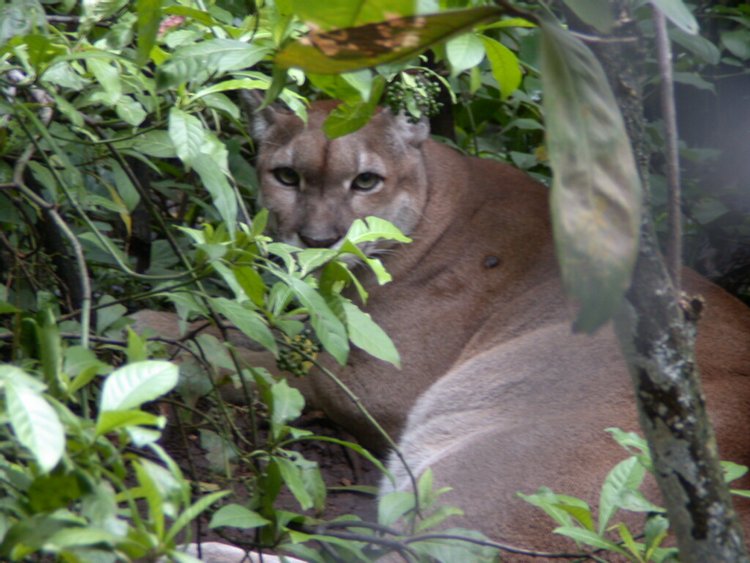
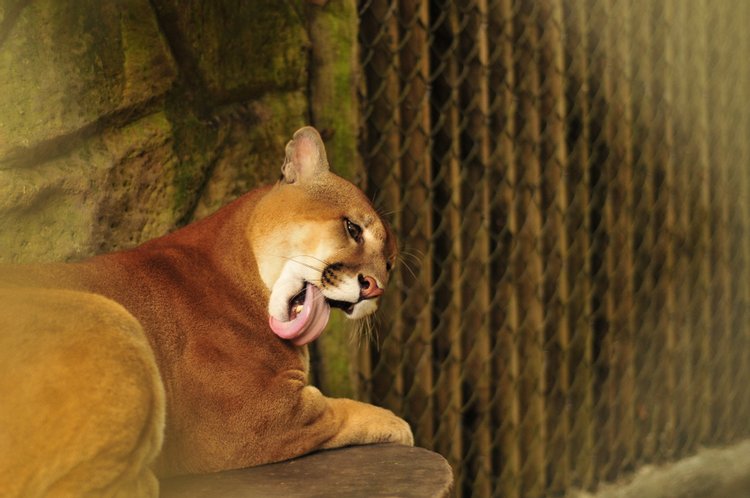
Puma (Puma concolor). Spanish name: Leon
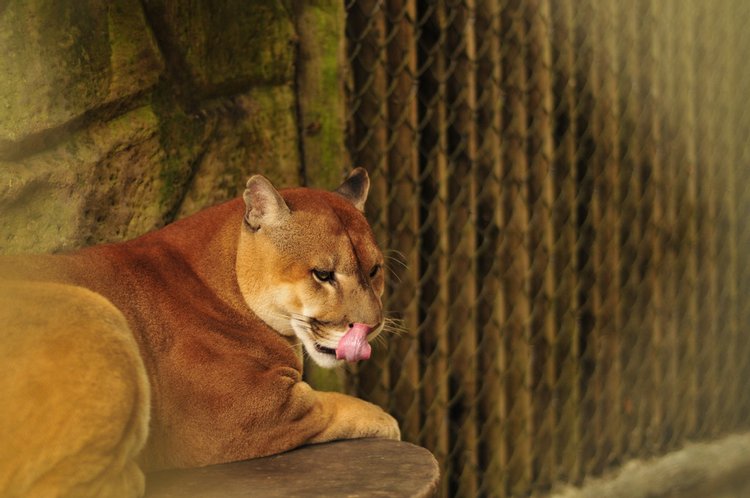
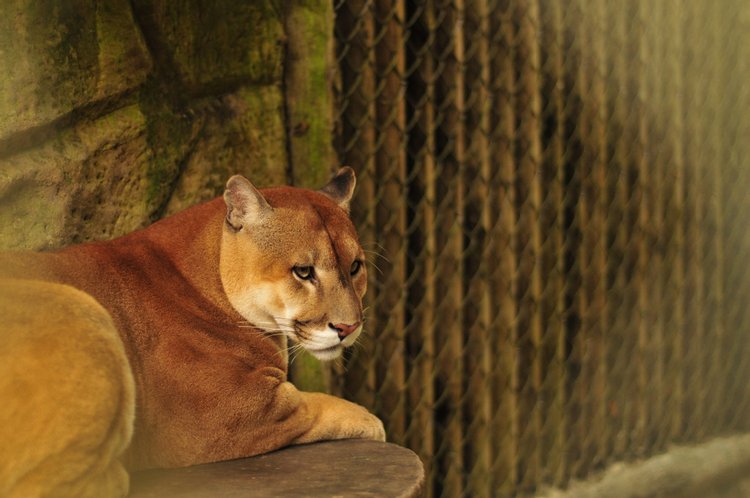
Habitat
The puma can tolerate habitats varying from temperate, coniferous forests to low, multistrata, and tropical rainforests.
Range
From British Columbia to Patagonia, the puma lives between elevations above 2,000 m down to sea level.
Physical Description
One of the largest cats in the Americas, the puma is second in weight only to the jaguar.
Adults are generally cinnamon to rufous brown with a white underside, but young pumas are spotted, and with subsequent molts their coloring gradually becomes more like that of adults. Until they are 6 months old, though, they can be difficult to tell from juveniles of the jaguar or other spotted cats.
Biology and Natural History
The tropical puma is smaller than its brother in temperate North America, most likely because it finds smaller prey in the Tropics. Still, the puma is an excellent hunter and athlete in the lower regions of its range: it can leap 16 feet into the air, and is a good climber even though it spends more time on the ground. The puma generally stalks its prey from behind, usually first attacking the back of the neck.
The puma can have 1-6 young to a litter, but generally has 2-3 kittens once every 2-3 years. This cat lives an average of 9 years in the wild, but can live to the age of 20 in captivity. Although this is indeed an adaptive big cat, an adult still requires a large territory of 75 km2 in the wild; an area of 100,000-200,000 ha is necessary to support a viable population unless there are sufficient corridors for them to contact each other. With deforestation and habitat destruction in the Tropics, it is becoming increasingly difficult for pumas to survive because there are fewer available areas large enough to support their territorial needs.
It also has the largest range of all terrestrial animals in the Americas, because it can tolerate a wide range of habitats. In the Tropics, the puma can overlap with the jaguar in range and territory, but the larger jaguar is usually dominant to the puma and the puma accordingly adjusts its placement to avoid contact with its cousin. Given enough space, this is not too difficult for the puma, since it can survive in a wider range of habitats than the jaguar. With its adaptability, the puma is more dominant even than the jaguar in southern Patagonia as well as at high elevations in the Andes.
In some places the puma has a misallocated reputation for being dangerous to humans. In the last 100 years, only 44 fatal attacks have been recorded over the entire span of the North and South American continents.
Diet
The puma specializes on medium to large game. In the northern range, it frequently hunts deer; in the Tropics, it often eats monkeys, rats, and coatis.
Height/Weight
Adult males can be more than 2.7 m long with a tail 60-70 cm long and weigh 60-100 kg. Females are smaller, 1.5 to 2.3 m total in length. Size varies over the geographic range of the species.
Taxonomy
Order: Carnivora
Family: Felidae
Sources
Eisenberg, John. Mammals of the Neotropics, Vol. 1. The University of Chicago Press: Chicago, 1989.
Wilson, D. E. in Janzen, Daniel H. Costa Rican Natural History. Chicago: University of Chicago Press, 1983.
-Amy Strieter, Wildlife Writer
Spider Monkey
Spider Monkey (Ateles geoffroyi) Spanish names: Mono Arana, Mono Colorado
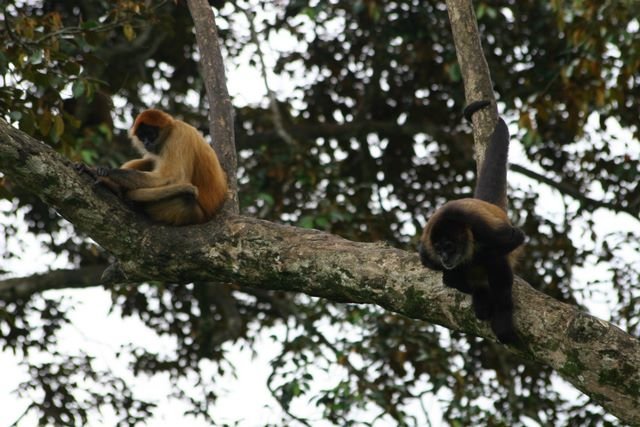
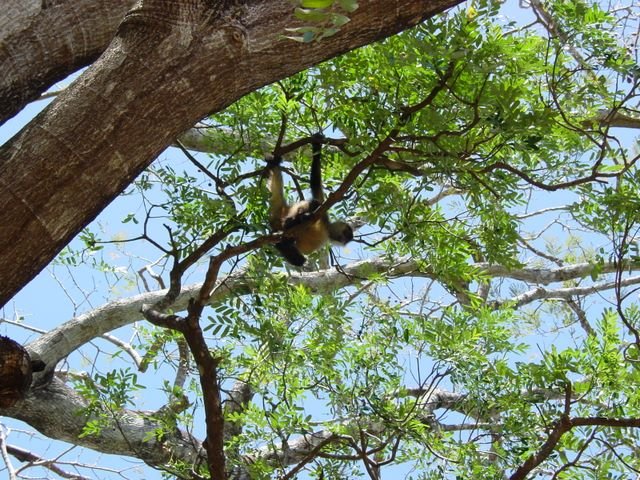
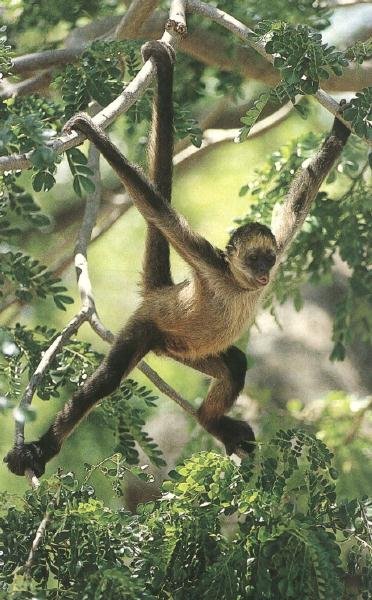
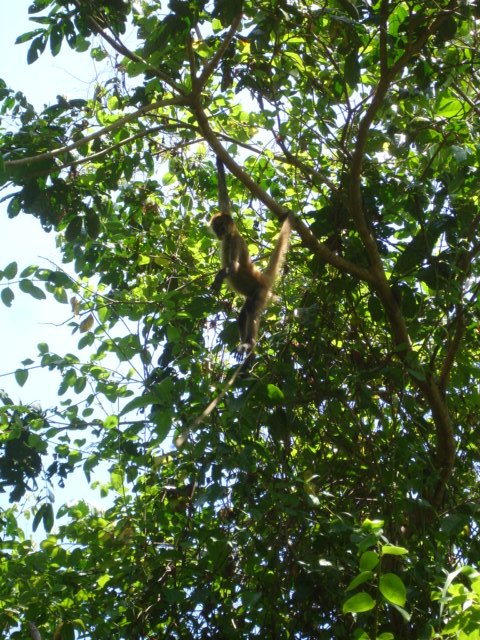
Habitat
Spider monkeys tend to stay high off the ground in the canopy of tropical forests.
Range
The genus of spider monkeys ranges from Southern Tamaulipas in Mexico to Mato Grosso in Brazil. This species formerly was abundant in many parts of Central America. Now, due to hunting and deforestation, it is restricted to areas with patches of forest large enough to sustain its troop size. How intensively it was and is hunted depends on the area of Central America; but because it is one of the largest New World primate species, it is more vulnerable to hunting.
Physical Description
This species contains 9 subspecies based on color variation; the color of the back, shoulders, and tail varies from blonde to black depending on subspecies.
Biology and Natural History
They speed through trees using their forelimbs and tail in a brachiating fashion. Their limbs are long and slender, and they have fully prehensile tails-the most prehensile of all Central American primates-that can support their full weight.
Their group dynamics are complicated and change in the course of a day. They tend to subdivide into small groups, most frequently of 2 to 3 individuals, but also into minitroop formations with an adult male, a few adult females and their young. At the end of the day these subgroups reconvene into a single unit at sleeping trees, at which point there are several adult males, juvenile males, adult females and offspring. Their total group size is usually about 20 individuals. Aside from gathering into this big group at certain feeding and sleeping trees, spider monkeys look for food independently or in their small groups.
A single troop requires a territory of 2.5 to 4 km2, so within their ranges they have a low population density compared to capuchins or howlers. Because spiders depend so heavily on fruit, which is harder to find than leaves, they need larger territories than their relatives.
Protecting these territories is only one function of their complicated communication system. They communicate using vocalizations, facial expressions, and posturing. Additionally, adult males secrete chemicals from their chest glands which they use to mark territories. Spiders have different calls associated with different situations: for example, barking rallies a mobbing conglomeration against terrestrial predators or territory invaders, and at least 2 types of long calls are used to coordinate troop movements. They use loud calls to bring the group together and to declare territory claim to other groups.
An infant spider monkeys stays close to its mother for 3 months, at first carried on the stomach then riding on her side as it ages. Babies remain at least partially dependent upon their mother's milk for the first year of life. Gestation lasts 225 days every 2 to 3 years; it is partly because of this slow reproductive time that spider monkeys are very sensitive to human disturbance, and their populations do not recover quickly when reduced by hunting or deforestation.
Diet
These monkeys are almost exclusively frugivores, but sometimes they will supplement their fruit diet with young leaves for additional plant-protein.
Height/Weight
Adults of both sexes can be more than 8 kg and 1.28 m long from head to tail-but the tail is longer than the body and head. Males may be slightly heavier and have a longer head and body length, but female tail length can exceed that of the male. Infants are 500 g at birth.
Taxonomy
Order: Primates
Family: Cebidae
Sources
Eisenberg, John. Mammals of the Neotropics, Vol. 1. The University of Chicago Press: Chicago, 1989.
Eisenberg, J. F. in Janzen, Daniel H. Costa Rican Natural History. Chicago: University of Chicago Press, 1983.
Wilson, D. E. in Janzen, Daniel H. Costa Rican Natural History. Chicago: University of Chicago Press, 1983.
-Amy Strieter, Wildlife Writer
Tours & Activities
Experiences in Corcovado National Park
Explore hand-picked Corcovado National Park tours and experiences led by local insiders, from wildlife encounters to cultural deep-dives.
Trips to Inspire
Corcovado National Park itineraries
Explore hand-picked Corcovado National Park itineraries designed by local insiders who know every hidden corner. Each trip is completely flexible, customized to your pace, travel style, and budget.
Inquire
36 days · Puerto Viejo de Limon, Tortuguero, Arenal, Monteverde +4
Couple
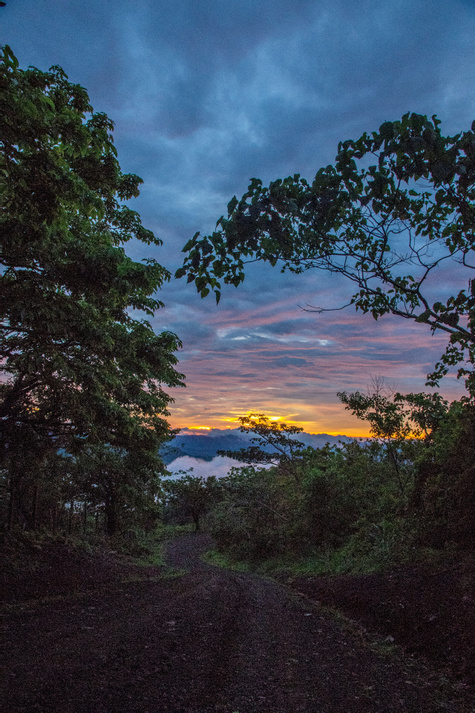
From misty cloud forests to sun‑kissed Pacific beaches, this Costa Rican adventure weaves together vibrant wildlife, volcanic landscapes, and endless ocean horizons. You’ll trek Monteverde’s canopy bridges, soak in Arenal’s hot springs, kayak mangroves at Drake Bay, and snorkel coral reefs off Manuel Antonio. Friendly local guides and community hosts will share traditions, cuisine, and conservation stories, leaving you with unforgettable memories of Costa Rica’s pura vida spirit.
Costa Rica
From $2,866 per person
23 days · San Gerardo de Dota, Puerto Jimenez, Drake Bay, Jaco +3
Family
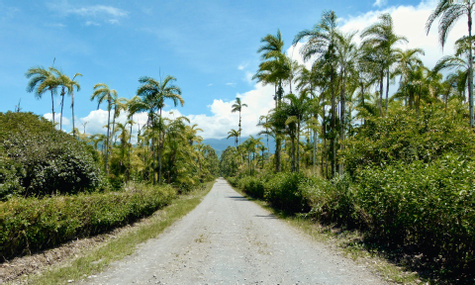
Emmett & Bridgette explored Costa Rica’s diverse landscapes on an extensive self‑drive adventure. From Corcovado’s rain‑soaked forest and Cabo Blanco’s coastal cliffs to Rio Celeste’s cloud‑forest, they hiked, kayaked mangroves, and floated down turquoise rivers. Friendly local guides shared conservation stories, letting both leave with a deeper respect for Costa Rica’s wild heart and its sustainable rhythms.
Costa Rica
From $1,499 per person
11 days · Tamarindo, Arenal, Drake Bay
Family
Anywhere.com allowed us to truly enjoy our experience vs. worrying that things weren’t arranged properly. Our 11-day adventure through Costa Rica yielded rich experiences and fond memories.

Costa Rica
From $2,032 per person
13 days · Uvita, Drake Bay, San Gerardo de Dota
Couple
We had a wonderful time and have already recommended Costa Rica and Anywhere Costa Rica to many of our friends.

Costa Rica